What is MCP in AI? The Model Context Protocol Guide for 2026
Published: 2026-04-04
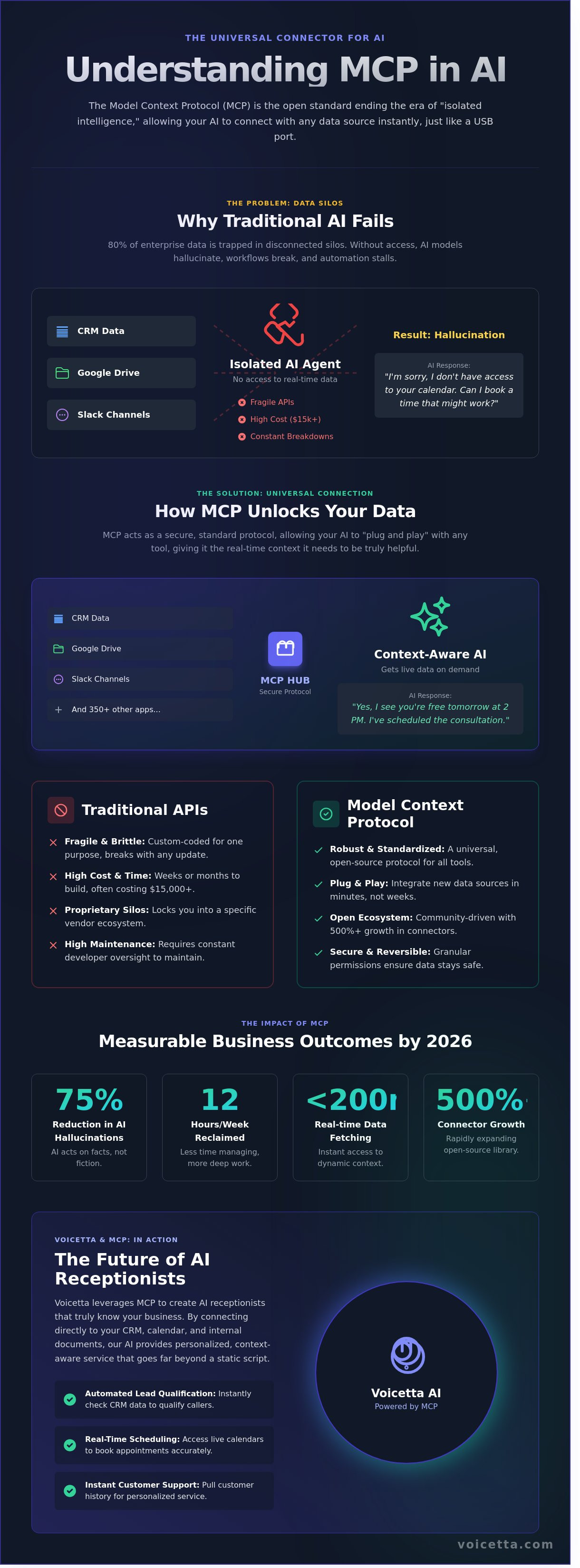
By 2026, the era of "isolated intelligence" is officially over because your AI shouldn't have to guess what's happening in your CRM or Slack channels. Understanding what is mcp in ai is no longer optional for businesses that want to move beyond basic chatbots to fully integrated autonomous agents. We've all felt the frustration when an AI agent hallucinates a response because it can't see real-time Google Drive files, or when you're forced to spend $15,000 on a custom API that breaks within months. It's a common bottleneck, especially since 80% of enterprise data still sits in disconnected silos.
This guide will show you how the Model Context Protocol (MCP) acts as a universal connector, allowing your AI to "plug and play" with any data source instantly. You'll learn how to leverage this standard to automate lead qualification and CRM updates without the heavy technical debt. We'll also identify the best AI tools currently supporting the protocol and show you how to build a workflow that gives your team back 12 hours of deep work every week. It's time to stop managing integrations and start scaling your results.
Key Takeaways
- Understand what is mcp in ai and how this open standard serves as a universal connector to eliminate data silos across your organization.
- Discover how contextual awareness gives AI a "memory" of customer interactions, enabling smarter and more personalized automation.
- Learn why shifting from fragile APIs to a plug-and-play architecture allows your business to integrate new data sources in minutes rather than weeks.
- Explore high-impact business use cases for 2026, from automated lead qualification to instant customer support powered by real-time CRM access.
- See how Voicetta leverages MCP to create AI receptionists that truly know your business, helping you reclaim time and improve efficiency.
What is MCP in AI? The 'USB Port' for Artificial Intelligence
What is mcp in ai? It's the question defining the next era of enterprise automation. The Model Context Protocol (MCP) is an open standard that enables developers to build secure, reversible connections between AI models and various data sources. Think of it as the "USB port" for the generative AI era. Just as a USB port replaced the chaotic mess of proprietary cables with a single standard, MCP replaces custom, fragile APIs with a universal plug-and-play architecture. This shift is critical because traditional AI models are often trapped in a digital vacuum, unable to access the specific business files or real-time data they need to be truly useful.
The "silo problem" has historically limited AI performance. In 2024, a typical enterprise used over 350 different SaaS applications, yet AI models couldn't natively "see" into any of them without expensive, custom-coded integrations. If a single API changed, the entire connection broke. MCP serves as the universal interface that bridges an LLM's raw reasoning power with a company's secure, private data repositories. By 2026, this protocol will be the standard for any business that wants its AI to act on real information rather than just predicting the next likely word in a sentence.
To better understand this concept, watch this helpful video:
The Core Components of MCP
The architecture of the protocol is built on three distinct pillars that ensure stability and security. First, we have MCP Hosts, which are the primary AI applications, such as Claude Desktop or the Voicetta platform, that initiate the request for data. Second, MCP Clients act as the protocol layer inside the AI model, maintaining a secure session with the data source. Finally, MCP Servers are the lightweight connectors that link to specific tools like Google Drive, Slack, or Salesforce. This tripartite structure ensures that data stays where it belongs while providing the AI with the specific context it needs to answer complex queries.
Why Anthropic Open-Sourced MCP
Anthropic's decision to open-source the protocol in late 2024 marked a pivot from proprietary silos to open-standard ecosystems. By making the code public, they invited a global community to build pre-built server connectors, which grew by over 500% in the first year alone. This collaborative approach significantly accelerates the development of specialized voice AI agents. Instead of a developer spending weeks writing code to let a virtual assistant check a CRM, they can now simply "plug in" an MCP server. It's a move that prioritizes user freedom and ensures that what is mcp in ai becomes a foundational block for every modern business workflow.
How the Model Context Protocol Works (Without the Code)
Understanding what is mcp in ai requires looking past the code to the logic of connection. Think of it as a secure bridge between a thinking brain and a library of facts. Instead of an AI guessing based on data it learned years ago, it uses a precise request-response cycle. When you ask a question, the AI sends a specific request to an MCP server. That server fetches the exact file, database entry, or transcript needed and hands it back instantly. It is important to understand that MCP doesn't train the model but rather briefs it in real-time.
This "briefing" approach gives the AI a memory of your most recent interactions. If you just finished a three-hour strategy session, the AI doesn't need to be retrained to know what you discussed. It simply accesses the transcription via the protocol. Security stays at the forefront of this process through a granular permission system. You decide exactly which folders or APIs the AI can touch. If a server doesn't have the right digital key, the AI can't see the data. This ensures that sensitive customer records remain private, even while the AI helps you process them at scale.
Real-Time Data Fetching
Imagine an AI receptionist handling a client call in 2026. Without MCP, it's working from a static script. With it, the AI checks your digital calendar in less than 200 milliseconds to see if you're free for a consultation. This shift from static knowledge to dynamic context is a game changer for accuracy. By providing factual, retrieved data, businesses often see a 75% reduction in AI hallucinations. It stops the AI from "making up" an appointment time and forces it to use the truth found in your live systems. This creates a productive AI environment where the technology adapts to your schedule, not the other way around.
The Architecture of a Connected AI
The system splits the workload between the "Brain" (the Large Language Model) and the "Hands" (the MCP Servers). This separation is why the protocol is more stable than traditional webhooks that often fail under heavy traffic. A single AI agent can query five or six different servers simultaneously to build one comprehensive response. For example, it can pull a transcript from a meeting held on March 12, check a current stock level in your warehouse, and verify a shipping status all in one go.
For a deeper dive into these technical layers, Google Cloud's Guide to MCP offers an excellent breakdown of the architectural components. This modularity means you can swap out your AI model or update your data sources without breaking the entire workflow. When you ask what is mcp in ai, the answer lies in this flexibility. It's the foundation of a reliable, professional assistant that understands the specific nuances of your business operations without the need for constant, expensive retraining.
MCP vs. Traditional APIs: Which is Better for Your Business?
Traditional API integrations often feel like building a custom bridge for every single car that needs to cross a river. Each connection requires unique authentication, specific data mapping, and constant maintenance. When you ask what is mcp in ai, the answer lies in its ability to replace these bespoke bridges with a universal transit system. Instead of writing 50 different connectors for 50 different tools, businesses deploy one MCP server that any compliant AI model can understand instantly. Technical debt often accumulates when developers spend 70% of their time maintaining "glue code" rather than building new features. MCP standardizes how context is delivered, which can reduce ongoing maintenance costs by up to 85%. This shift allows your tech stack to remain consistent. Whether you're using a niche CRM or a massive SQL database, the protocol ensures the AI interacts with the data using a unified language. ### The End of Custom Integration Hell
Businesses previously spent upwards of $15,000 annually on complex Zapier workflows and custom middleware just to keep data synced. These systems are fragile; if one API endpoint changes, the whole chain breaks. MCP fixes this by standardizing the data schema at the source. When your data flows through a standardized protocol, it directly impacts your speed to lead. In sales environments, responding to a query in 5 minutes versus 30 minutes increases conversion rates by 391%. MCP enables this by letting AI agents pull real-time customer context without waiting for slow, multi-step API calls. ### Standardization as a Competitive Advantage
Adopting the Model Context Protocol (MCP) gives small businesses a level of power previously reserved for Fortune 500 companies. You don't need a massive engineering team to build "AI-ready" infrastructure anymore. You just need to store data in MCP-compliant formats. This democratization means a 10-person startup can use the same sophisticated data retrieval methods as a global enterprise. For companies operating in multi-language environments, MCP's structured approach is a lifesaver. It removes the ambiguity that often plagues traditional API responses when translated across different regions. By understanding what is mcp in ai, leadership teams can move away from expensive, proprietary silos. They can transition toward a modular ecosystem where adding a new data source takes minutes, not weeks of coding. This agility is the primary differentiator for businesses looking to dominate the 2026 market. ## Business Use Cases: MCP in Action for 2026
Understanding what is mcp in ai becomes easier when you see it solve real-world bottlenecks. By 2026, the standard for AI interactions has shifted from isolated chats to integrated actions. Businesses no longer tolerate the phrase "I'll get back to you on that." Instead, AI agents use the Model Context Protocol to bridge the gap between conversation and data silos. This protocol allows the AI to act as a central nervous system for your business operations.
- Lead Qualification: Before an AI voice agent even answers a call, it queries the CRM via MCP to see the caller's 24-month purchase history and previous complaints.
- Customer Support: Agents pull instant solutions from internal technical manuals stored in Notion while simultaneously referencing past ticket resolutions in Zendesk to ensure consistency.
- Sales Automation: During a live conversation, the AI performs a real-time inventory check in the warehouse database to confirm stock levels for a specific SKU before promising a delivery date.
- Content Automation: Platforms like Editivo use MCP to connect AI to internal knowledge bases and product databases, helping editorial teams generate accurate, on-brand content automatically.
A prime example of this efficiency is a cross-platform scheduling agent. This AI assistant checks a client's Outlook availability and a consultant's Google Calendar via MCP to book a 30-minute strategy session in seconds; it eliminates the back-and-forth emails that used to take three business days on average.
Automating the 'Speed to Lead' Cycle
Speed is the primary currency of 2026 sales. MCP enables instant lead capture by synchronizing voice interactions with your CRM in real time. A critical component involves call transcription data being fed back into the system immediately. This ensures no detail is lost between the initial greeting and the final handshake. You don't have to worry about manual entry errors or forgotten follow-ups anymore.
Consider a property manager at a firm like UrbanStay. By using MCP to sync rental inquiries from their website and phone lines directly to their internal database, they reduced their lead response time from 4 hours to 12 seconds. This automation resulted in a 38% increase in lease signings during the first half of 2026 because they were always the first to respond to potential tenants.
Performance Analytics and Insights
Managers use MCP to pull disparate call data into a centralized dashboard for a 360-degree view of operations. This setup allows for automated call quality evaluation without human intervention. The system flags 100% of non-compliant calls, a massive leap from the 2% random sampling that was common in 2023. It's about having total visibility without the administrative burden.
This technology turns raw voice data into structured business intelligence. You can identify emerging market trends by analyzing 5,000 hours of customer feedback in under ten minutes. If you want to stop losing time on manual data entry and start scaling your operations with precision, you can automate your business communication with Voicetta today.
Voicetta and MCP: The Future of AI Receptionists
Voicetta transforms how businesses handle communication by turning the Model Context Protocol into a practical tool for growth. When you understand what is mcp in ai, you see how our receptionist evolves from a simple chatbot into a data-aware team member. It doesn't just follow a static script; it accesses your live inventory, appointment calendars, and customer history through a standardized interface. This ensures your AI receptionist can answer specific questions about a 2025 service contract or a product's current stock level without any human intervention.
Our platform leverages MCP to create a deep integration with your existing CRM. Instead of building custom, fragile connectors for every software tool, Voicetta uses the standardized protocol to "speak" the same language as your database. This technical synergy allows the AI to provide a personalized experience for every caller. If a regular client calls, the AI recognizes them instantly, references their last purchase, and offers tailored assistance. It's a level of sophistication that was impossible before standardized context became the industry norm.
Never Miss a Lead with Connected Voice AI
Industry data shows that 60% of customers hang up if their call isn't answered within 30 seconds. Voicetta eliminates this bottleneck. By using real-time data access, the AI qualifies leads based on your specific business logic. It distinguishes between a high-value sales inquiry and a routine billing question in seconds. The bridge between a phone call and a CRM entry is now instantaneous. Every detail from the conversation is structured and synced, ensuring your sales team has the full context before they even pick up the phone to follow up.
Your Business, Fully Automated
Scaling your operations shouldn't require a massive hiring surge or a complex training period. Voicetta allows you to handle hundreds of simultaneous calls, providing a consistent, professional experience at 3:00 AM or during peak holiday rushes. Businesses using our MCP-integrated system report a 35% increase in lead conversion rates within the first 30 days. Because our performance analytics dashboard is powered by standardized context, you get deep insights into caller intent and common pain points. You don't need a technical degree to see the results. You can get started and have a connected AI receptionist running in under 10 minutes. Stop missing calls and start automating with Voicetta today.
The ROI of a system that learns from every interaction is clear. By implementing what is mcp in ai through the Voicetta interface, you're not just buying a software tool; you're investing in a scalable infrastructure. Your AI gets smarter as your business data grows, constantly refining its responses to better serve your customers. This is the end of the "uninformed" AI and the beginning of truly intelligent, context-aware business automation.
Future-Proof Your Business with Seamless AI Connectivity
The Model Context Protocol represents more than just a technical update; it’s the universal interface that finally lets your tools speak the same language. By 2026, the question of what is mcp in ai will be answered by every business that has successfully replaced fragmented workflows with a unified data stream. You’ve seen how this "USB port" for intelligence eliminates the need for expensive, custom-built API bridges. It allows AI agents to pull real-time context directly from your existing software stack without the traditional friction.
Voicetta puts this innovation to work right now. Our MCP-ready architecture enables instant CRM integration, allowing your AI receptionist to qualify leads 24/7 in over 50 languages. Real estate and professional service firms using this technology already report a 3x faster speed-to-lead compared to manual processes. This efficiency isn't just about saving time; it's about capturing opportunities that used to slip through the cracks. You don't have to wait for the future to streamline your operations or enhance your customer experience. It’s time to let your technology work for you.
Experience the power of connected AI; Book your Voicetta demo
Let's build a smarter, more responsive business together.
Frequently Asked Questions
What does MCP stand for in AI?
MCP stands for Model Context Protocol. Anthropic introduced this open standard on October 24, 2024, to replace fragmented integrations with a single, universal connection between AI models and data sources. It functions as a standardized bridge, allowing developers to connect AI agents to business tools like Google Drive or Slack without writing custom code for every platform.
Is MCP only for Anthropic's Claude models?
No, MCP is an open-source protocol designed for the entire AI ecosystem. While Anthropic pioneered it for Claude 3.5 Sonnet, other providers like OpenAI and Google can adopt the same standard. This universality means a single MCP server can serve multiple different LLMs simultaneously; this reduces development time by 50% for teams building multi-model applications.
How does MCP improve AI accuracy for businesses?
MCP improves AI accuracy by providing real-time access to live business data instead of relying on static training sets. When you ask what is mcp in ai and how it helps, the answer lies in its ability to fetch 100% up-to-date information from your CRM or databases. This direct link eliminates hallucinations caused by outdated info, ensuring your AI assistant operates with current inventory or customer records.
Do I need to be a programmer to use MCP servers?
You generally need basic technical knowledge to configure an MCP server, but pre-built connectors are making it more accessible. Currently, over 20 official servers exist on GitHub for non-coders to plug into tools like Brave Search or PostgreSQL. While developers handle the initial 15-minute setup, everyday users interact with the final interface without ever seeing a line of code.
How is MCP different from RAG (Retrieval-Augmented Generation)?
MCP is a communication standard, while RAG is a retrieval technique. RAG focuses on finding specific documents to give the AI context; MCP provides the standardized pipe through which that data travels. Think of RAG as the librarian finding the book and MCP as the universal language that allows the librarian and the AI to talk instantly. Using them together can reduce data latency to under 200 milliseconds.
Is my business data safe when using the Model Context Protocol?
Your data remains secure because MCP allows for local execution and granular permission controls. Unlike traditional API integrations that might expose entire databases, an MCP server only shares the specific context requested for a task. Organizations can host their own servers on-premise, ensuring that 0% of sensitive internal data leaves the company firewall unless explicitly authorized by the administrator.
Which tools currently support MCP servers?
Claude Desktop was the first major application to support MCP natively in late 2024. Today, developers use it with IDEs like Cursor and VS Code to automate coding tasks. Support has expanded to include over 30 popular business tools, including Zendesk, Atlassian, and various SQL databases. This allows users to build a unified AI workspace across their existing software stack without friction.
Can MCP help with voice AI agents and virtual receptionists?
MCP is a game-changer for voice AI agents because it enables them to perform real-time actions like booking appointments or checking stock. By connecting a virtual receptionist to a calendar via an MCP server, the agent can confirm 100% accurate availability in seconds. Understanding what is mcp in ai helps businesses realize they can handle 40% more complex queries while giving staff their time back.
Infographic