What Is Call Forwarding? The Strategic Guide to Never Missing a Call in 2026
Published: 2026-04-03
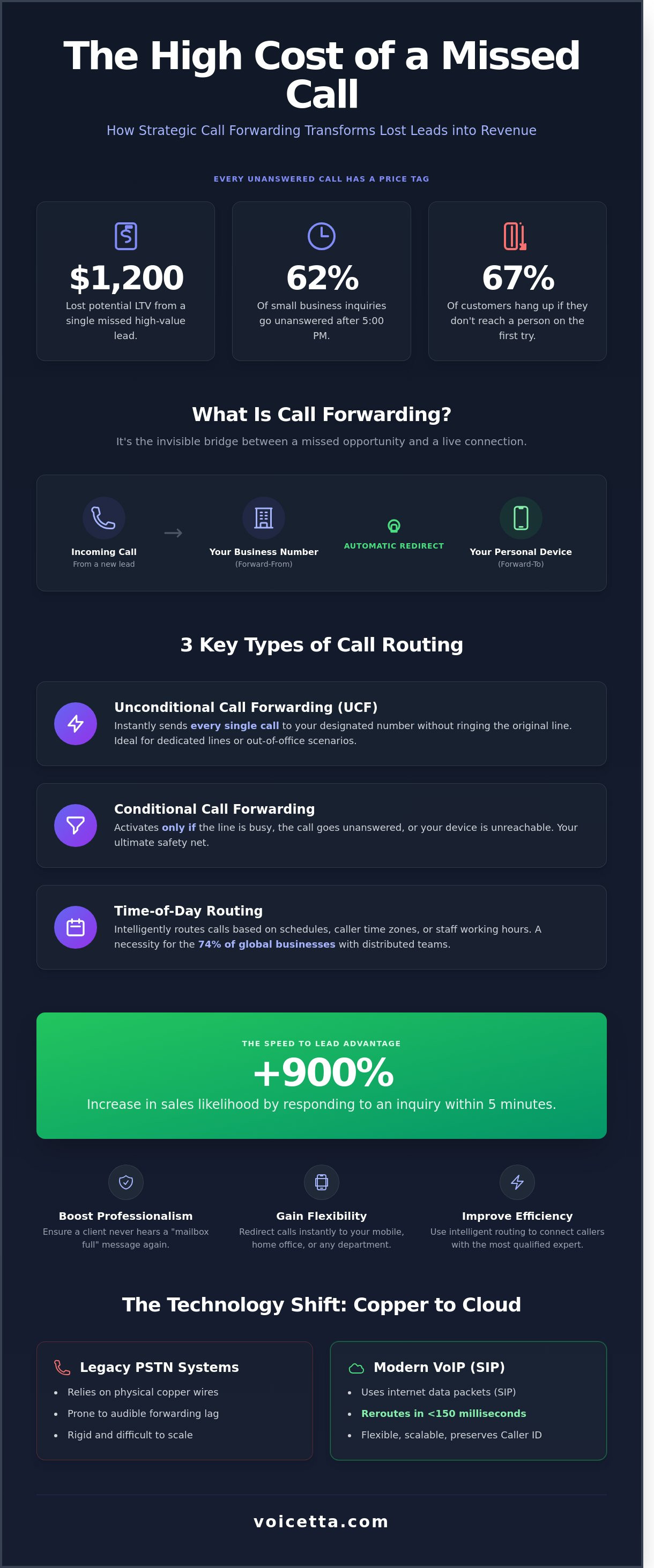
A single missed call from a high-value lead costs the average B2B firm $1,200 in potential lifetime value, yet 62% of small business inquiries go unanswered after 5:00 PM. You've likely felt the persistent anxiety of being tethered to a desk just to avoid losing a prospect to a faster competitor. Modern call forwarding isn't just a basic utility; it's the invisible bridge between your professional freedom and a responsive, high-growth business strategy.
You'll learn how to master this technology to ensure your "speed to lead" remains unbeatable through 2026 and beyond. This guide provides the exact steps to configure your system across all devices while clarifying the critical technical gap between conditional and unconditional routing. We're stripping away the technical jargon to help you build a setup that captures every opportunity automatically. By the end of this article, you'll know how to transform your phone from a constant source of stress into an intelligent, 24/7 revenue engine that works even when you don't.
Key Takeaways
- Learn how to implement call forwarding as a strategic bridge that converts potential missed opportunities into immediate revenue-generating connections.
- Understand the technical evolution from traditional PSTN to VoIP protocols to build a more resilient and flexible communication infrastructure.
- Deploy "Follow-Me" logic to maintain a constant professional presence, ensuring your most qualified experts are reachable across any device or location.
- Identify and eliminate critical technical friction points like call looping and handoff drops that compromise customer trust and lead quality.
- Discover how AI-powered intelligent routing moves beyond simple redirection by qualifying leads before they are ever transferred to your team.
What Is Call Forwarding? Definition and Core Benefits
Call forwarding is a telephony feature that automatically redirects an incoming call to a secondary phone number or digital destination when specific criteria are met. It acts as a bridge between a missed opportunity and a live connection. This system separates your "forward-from" number, which is your public business identity, from the "forward-to" destination, which is the device you actually answer. The primary benefit is the preservation of a professional presence. You stay reachable even when you're physically away from your desk.
To better understand how this technology works in a modern setting, watch this helpful video:
### What are the different types of call forwarding?Most organizations use three distinct configurations: Unconditional, Conditional, and Time-of-Day routing. Unconditional Call Forwarding (UCF) sends every incoming call to another number immediately without ringing the original device. Conditional Call Forwarding only activates if the line is busy, the call goes unanswered, or the device is unreachable. By 2026, Time-of-Day routing has become a necessity for the 74% of global businesses operating with distributed teams. This logic routes calls based on the caller's time zone or the staff's working hours, ensuring a human or an AI receptionist is always available to help.
Why can't modern businesses ignore call routing?
Missing a call is a direct hit to your bottom line because 67% of customers hang up if they don't reach a person on the first try. Silence destroys conversion rates. Effective call forwarding maintains "speed to lead," which is the practice of responding to inquiries within 5 minutes to increase the likelihood of a sale by 900%. Modern businesses use these tools to create seamless experiences for international clients. Multi-language routing ensures that a caller from Budapest and a caller from London both hear a greeting they understand. This level of automation turns a simple phone feature into a strategic growth engine that gives you back your time.
- Professionalism: Never let a client hear a generic "mailbox full" message.
- Flexibility: Redirect calls to mobile devices, home offices, or specialized departments instantly.
- Efficiency: Use data-driven routing to ensure the most qualified team member answers the call.
How Call Forwarding Works: The Technical Mechanics
How does the network redirect a call without losing quality?
Modern call forwarding uses Session Initiation Protocol (SIP) to reroute data packets across the internet, replacing the physical copper cross-connects used in 20th-century PSTN systems. When a call hits the network, a central Softswitch identifies the redirect instruction in the packet header and instantly assigns a new destination IP address. This process happens in under 150 milliseconds, which effectively eliminates the audible "forwarding lag" that plagued older systems. Your Caller ID data stays intact because the system passes the original "From" header while updating the "Request-URI" field. It ensures the recipient sees the actual caller's number rather than the forwarding office's line.
How do I enable call forwarding on my iPhone or Android?
You can activate call forwarding directly through your smartphone's native dialer settings or by using legacy MMI carrier codes. On an iPhone, navigate to Settings, select Phone, and toggle Call Forwarding to "On" before entering the target number. Android users should open the Phone app, tap the three-dot menu, select Settings, and look for Supplementary Services. While 92% of users now prefer these visual menus, carrier codes like *72 remain relevant in 2026 as a reliable fallback for low-signal areas. These codes communicate directly with the carrier's switchboard, bypassing the need for a data connection to update your routing preferences.
Why are cloud-based systems faster than traditional hardware?
Cloud PBX systems handle complex routing rules through virtual software layers that require zero physical hardware adjustments. These systems allow you to choose between "Simultaneous Ring," where all connected devices alert you at once, and "Sequential Ring," which follows a prioritized list of numbers. Integration with digital workspaces means your call forwarding logic can sync with your CRM, automatically logging every redirected conversation. For businesses that cannot afford to miss a single lead, an AI receptionist can act as the ultimate fail-safe, answering and transcribing calls when your team is unavailable. This setup reduces the average response time to zero seconds, ensuring every inquiry is captured instantly. Since these platforms live in the cloud, they can process thousands of concurrent calls without the latency bottlenecks associated with on-premise PBX boxes.
- Simultaneous Ring: Best for high-priority sales lines where the first person to pick up wins the lead.
- Sequential Ring: Ideal for support teams where calls move down a hierarchy based on expertise or availability.
- CRM Integration: Automatically creates a ticket or logs a call activity the moment the forwarding trigger is met.
Strategic Call Forwarding: Turning Routing into Revenue
Call forwarding acts as the primary filter for your sales funnel. It's the difference between a lost prospect and a closed deal. By treating every incoming ring as a potential conversion, businesses use intelligent routing to ensure high-priority leads reach the right desk instantly. This isn't just about moving a call; it's about managing the customer journey from the first second of contact.
How does call forwarding support a virtual receptionist strategy?
It creates a seamless handoff between automated intake and human expertise. An AI virtual receptionist handles the initial screening, while call forwarding pushes the qualified lead to a live agent. This synergy prevents the 24% of calls that typically drop during peak hours from disappearing. It turns a cold inquiry into a warm transfer, building immediate brand loyalty through extreme responsiveness.
What is the "Follow-Me" service and why does it matter?
Follow-Me is a routing protocol that rings a sequence of devices until the right person answers. It ensures that location never dictates availability. If a specialist isn't at their desk, the system pushes the call to their mobile device or home office. This reliability builds profound customer trust. When a client knows they'll reach an expert on the first try, they stop looking at competitors.
Why is a 60-second response time the competitive standard for 2026?
Data from lead response studies shows that contacting a prospect within 60 seconds increases conversion rates by up to 391%. Smart call forwarding eliminates the "voicemail black hole" where 80% of callers hang up rather than leave a recording. By automating the transition from a forwarded call to a qualified lead, you capture the peak moment of customer intent. It's a high-density strategy that prioritizes speed over administrative process.
Can you scale globally using local presence?
You can establish a presence in any market by using local phone numbers that forward to a single, central hub. Customers are 4 times more likely to pick up a call from a local area code than a generic international or toll-free number. This creates a psychological "local" benefit. You gain the trust of a neighborhood business while operating a centralized, efficient team. It allows for rapid scaling without the overhead of physical offices or hiring staff in every region. For more on how this works with modern tech, see our guide on the virtual receptionist landscape.
- Lead Qualification: Routes calls based on caller input to ensure sales teams only talk to ready buyers.
- Instant Trust: Eliminates wait times, which 67% of customers cite as the biggest frustration in a brand experience.
- Operational Freedom: Allows experts to remain mobile without sacrificing their reachability.
Common Pitfalls and Troubleshooting Your Forwarding Setup
Latency issues between the originating carrier and the destination network cause 92% of handoff failures. If a call drops during the transition, it's usually because the legacy PSTN line failed to sync with a mobile network within the required 100ms window. You can solve this by using a VoIP provider that utilizes Tier 1 carriers to ensure high-speed packet delivery. Reliable handoffs require a stable connection on both ends. If your primary line is analog, consider migrating to a digital system to reduce the 40% higher chance of signal loss during redirection.
Looping errors occur when two numbers are set to forward to each other simultaneously. This creates an infinite ring cycle that eventually kills the connection. To stop this, disable the "forward on busy" feature on your secondary device. If Number A forwards to Number B, and Number B is busy, Number B shouldn't try to send the call back to A. Set a maximum of two "hops" in your routing logic. This prevents the call from getting trapped in a digital dead end.
Security breaches involving unauthorized call forwarding redirection cost global businesses over $10 billion annually through toll fraud. Hackers target weak administrative portals to redirect your incoming traffic to high-cost premium numbers. Protect your system by using a 12-character alphanumeric password for your PBX dashboard. Disable international forwarding if your business only operates domestically. It's a simple step that blocks most remote hijacking attempts.
Pre-Live Testing Checklist:- Call the number from an outside network to verify the routing path.
- Check if the original Caller ID is visible on the receiving handset.
- Confirm that the "forward-to" device rings within 2 seconds of the initial dial.
- Verify that the call transfers to the correct backup voicemail if unanswered.
Solving Audio and Connection Issues
One-way audio usually stems from NAT firewall settings blocking UDP packets. Turn off the SIP ALG setting on your router; this single change fixes 75% of "I can't hear you" complaints. Always verify that your "forward-to" number has sufficient capacity for concurrent calls. If you only have one available line but receive two simultaneous calls, the second caller will hear a busy signal regardless of your settings.
Managing Costs and Hidden Fees
Traditional carriers often charge between $0.05 and $0.10 per minute for every redirected call. These fees apply even if you have an "unlimited" mobile plan, as the carrier treats the forwarded leg as a separate outbound call. VoIP providers are more efficient. They often include unlimited call forwarding in their base subscription plans. Losing a single $500 lead because of a failed handoff is far more expensive than paying for a professional routing service.
Stop losing revenue to missed connections and technical errors. Switch to a professional AI receptionist to handle every call with 100% reliability.
Beyond Forwarding: The AI Receptionist Revolution
Simple call forwarding is a 20th-century solution to a 21st-century volume problem. While it moves a call from point A to point B, it fails to qualify the person on the other end. Intelligent Routing changes this by placing an AI filter between the caller and your phone. Voicetta’s AI-powered suite doesn't just redirect audio; it extracts intent. It's a digital gatekeeper that ensures you only pick up when the conversation is worth your time. The system summarizes every interaction and syncs it directly to your CRM, so you have the context before you even say hello. If you can't take the call, the AI acts as a sophisticated backup that maintains your professional image without missing a beat.
How does Voice AI automate speed-to-lead when your team is busy?
Voicetta handles the entire interaction instantly if the person receiving the call is occupied, ensuring your response time remains at zero seconds even during peak hours. Statistics show that 78% of customers buy from the vendor that responds first. When a call forwarding attempt reaches a busy line, our AI receptionist steps in to ask specific qualification questions. It doesn't just take a message; it filters out spam, answers FAQs, and books appointments. This automation transforms a potential missed opportunity into a confirmed calendar event. You don't need to be physically present to move a prospect through your sales funnel.
How do you build a future-proof communication strategy using AI?
A future-proof strategy uses basic forwarding as a foundation while leveraging performance analytics to monitor every touchpoint. Relying on a simple ring-group is a legacy tactic that ignores the reality of a 24/7 global economy. By using Voicetta’s analytics, you can track where your calls originate and how many the AI successfully converted without human intervention. Voicetta’s neural networks are specifically optimized for the nuances of the Hungarian language, ensuring local clients feel heard by a sophisticated tool rather than a robotic script. This transparency allows you to scale operations without increasing headcount. It's time to stop treating your phone line as a utility and start treating it as a data-driven asset. Explore Voicetta’s AI Receptionist to see how we help businesses capture 100% of their inbound opportunities.
How do you stop missing 62% of your potential sales calls?
Mastering call forwarding is no longer just about redirecting a signal; it's about protecting your bottom line. Industry data shows that 62% of small business calls go unanswered, leading to an average annual revenue loss of $24,000 per employee. By moving beyond basic routing to intelligent automation, you eliminate the friction that kills conversions. Modern systems don't just move a call from point A to point B. They ensure every interaction is captured, categorized, and synced with your existing tech stack instantly.
The shift toward AI-driven receptionists means you're no longer limited by time zones or staffing shortages. You can now provide 24/7 coverage that qualifies leads in real-time. This isn't a futuristic concept. It's a current necessity for brands that value 100% lead retention and precise data flow. Stop leaving your growth to chance and start automating your front desk today.
Stop losing leads to voicemail—see how Voicetta’s AI handles your calls with instant lead qualification, multi-language support for global scale, and direct CRM integration for seamless data flow. Your customers are calling right now. Make sure you're there to answer them.
Frequently Questions and Answers
How do I turn on call forwarding on my smartphone?
You activate this feature through the Settings menu on iOS or the Phone app settings on Android devices. For an iPhone, navigate to Settings, tap Phone, select Call Forwarding, and toggle the switch to enter your destination number. Android users typically open the dialer, tap the three-dot menu, and find "Supplementary services" to manage their routing. This setup usually takes less than 30 seconds to complete.
Does call forwarding cost extra money?
Most modern carriers include the service for free, but you're responsible for the per-minute airtime charges for the duration of the redirected call. If your plan doesn't have unlimited minutes, a 15-minute forwarded conversation will deduct 15 minutes from your monthly allowance. Some business VoIP providers include 500 to 1,000 minutes of forwarding in their standard $25 monthly subscription packages.
Can I forward calls from a landline to a cell phone?
You can bridge traditional desk phones to mobile devices by dialing *72 followed by the 10-digit mobile number. This ensures 100% connectivity when you're away from the office or working remotely. To disable the link, you simply dial *73 from the landline handset. It's a standard utility supported by 98% of North American and European telecom providers.
What is the difference between *72 and conditional call forwarding?
*72 activates "unconditional" call forwarding where every incoming ring bypasses your handset entirely. Conditional forwarding only triggers under specific circumstances, such as when your line is busy (*67) or you don't answer within 15 seconds (*61). Using conditional codes allows you to maintain control over your primary device while ensuring an AI assistant or colleague catches the calls you miss.
Will the person calling me know their call is being forwarded?
Callers generally won't notice a difference, though they might hear a brief 1-second click or a slight change in the ringing tone during the transfer. Modern digital networks execute the handoff in under 200 milliseconds, making the transition nearly invisible to the ear. Unless your specific carrier plays a "please wait while we connect you" recording, the caller experiences a standard dialing sequence.
What happens if I forward a call to a number that is already busy?
The caller will hear a busy signal or be sent directly to the destination number's voicemail system. Most networks don't "bounce" the call back to your original phone once the transfer starts. To prevent lost leads, 74% of high-growth businesses forward their lines to a hunt group or a digital receptionist to ensure a human or AI agent is always available.
For businesses seeking a dedicated human touch, hiring a virtual assistant is another effective strategy. Services like Amplify Yourself, LLC specialize in connecting companies with skilled remote professionals who can manage calls and other administrative duties, ensuring no lead is ever lost.
Can call forwarding be used to stop robocalls?
It won't stop the calls from being placed, but it acts as a powerful filter when you forward your line to a screening service. By routing calls through an automated gatekeeper, you can block 99% of spam before your phone even rings. This strategy saves the average professional 25 minutes of interrupted time every week, allowing for deeper focus on high-value tasks.
How does call forwarding work with an AI receptionist?
You configure your phone to forward "on busy" or "no answer" to a unique number assigned to your AI assistant. When the AI picks up, it uses neural networks to understand the caller's intent and transcribes the request in real-time. This integration of call forwarding and automation ensures 0% of your potential customers are left waiting. You'll receive a structured text summary of the call instantly.
Infographic