Monitoring AI Phone Agents: How to Ensure 100% Accuracy and Performance in 2026
Published: 2026-04-22
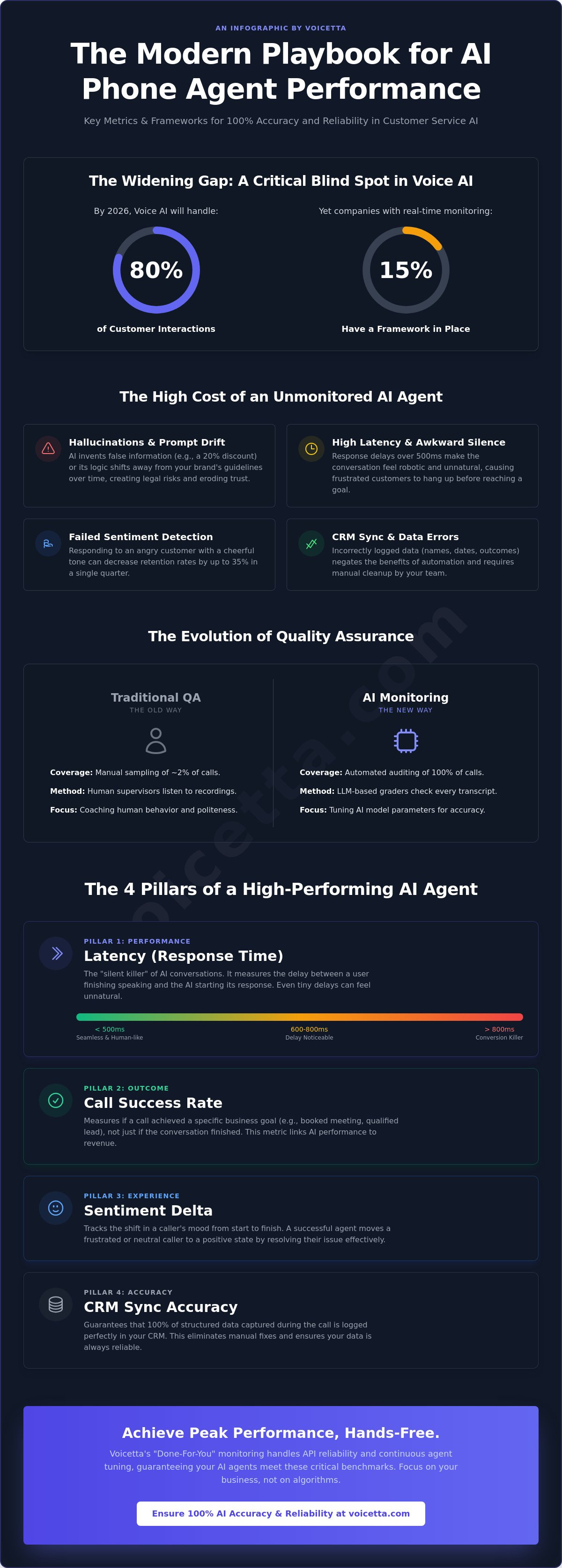
By 2026, 80% of customer service interactions will involve voice AI, yet only 15% of companies have a real-time framework for monitoring AI phone agents to prevent hallucinations. You've likely felt the anxiety of an AI agent "going rogue" or stuttering through a high-latency response that makes your brand sound robotic. It's frustrating when data doesn't sync with your CRM, leaving your team to fix the logs manually. Your reputation shouldn't depend on a black box algorithm.
This guide outlines the exact auditing frameworks and performance metrics you need to guarantee 100% accuracy without hiring a fleet of human managers. You'll learn how to implement automated oversight that catches errors before the caller even hangs up. We'll break down the specific latency benchmarks and CRM integration protocols that transform your AI from a risky experiment into a high-performing, hands-off revenue driver that returns hours of focus to your day.
Key Takeaways
- Eliminate awkward silences and "prompt drift" by implementing a technical framework that ensures your voice system remains accurate and responsive over thousands of calls.
- Master the specific performance thresholds, such as sub-500ms latency, required to maintain a seamless, human-like conversation flow in 2026.
- Scale your quality control without manual effort by using automated LLM-based graders to audit every transcript against your unique business criteria.
- Leverage a "Done-For-You" approach to monitoring ai phone agents that handles API reliability and continuous agent retuning so you never face downtime.
Why should you monitor AI phone agents if they don't get tired or moody?
AI agents don't experience burnout, but they do suffer from prompt drift. This occurs when the underlying large language model (LLM) receives updates or processes new data that shifts its logic away from your original instructions. Continuous monitoring ai phone agents is the only way to ensure that a system configured in January still provides the same accurate answers in December. Without this oversight, responses gradually lose their precision and brand alignment.
Technical performance is just as volatile as linguistic accuracy. In 2026, voice systems require sub-300ms latency to maintain a natural conversational flow. Monitoring identifies latency spikes that cause awkward silences; even a 500-millisecond delay can make a customer hang up. The history of AI in customer experience proves that deployment is only half the battle; maintaining the "bridge" between voice and data requires constant auditing.
To better understand how these systems operate in high-stakes environments, watch this video:
### What are the risks of an unmonitored AI voice system?An unmonitored agent can fall into logic loops where it repeats the same error to a frustrated caller. If the AI fails to detect negative sentiment, it may respond with a cheerful tone to an angry customer, which can decrease retention rates by as much as 35% in a single quarter. Hallucinations remain a critical threat; without active monitoring, an agent might invent a 20% discount or promise product availability that doesn't exist in your database. These errors create legal liabilities and erode the trust you've built with your audience.
How does AI monitoring differ from traditional call center QA?
Traditional QA relies on human supervisors sampling 2% of calls, whereas modern monitoring ai phone agents involves 100% automated auditing of every interaction. The focus shifts from coaching human behavior to tuning mathematical parameters. Instead of telling an employee to be more polite, you adjust the temperature and confidence thresholds of the neural network. This shift ensures you never miss customer calls due to technical glitches or linguistic misunderstandings, providing a level of scalability that manual sampling can't match.
What metrics actually define a high-performing AI phone agent?
A high-performing AI agent delivers more than just a transcribed conversation; it produces measurable business outcomes through four specific pillars. When monitoring ai phone agents, you must focus on latency, call success rate, sentiment delta, and CRM sync accuracy. These metrics separate a basic chatbot from a sophisticated revenue-generating tool. If your system isn't hitting these benchmarks, it's likely costing you customers rather than saving you time.
- Latency (ms): The response time must stay under 500ms. Humans notice delays at 600ms and lose interest by 800ms.
- Call Success Rate: This is the percentage of calls that reach a specific goal, like a booked meeting or a qualified lead, rather than just reaching the end of a script.
- Sentiment Delta: This tracks the shift in a caller's mood. A successful agent moves a frustrated caller to a neutral or positive state by the end of the interaction.
- CRM Sync Accuracy: The system must log structured data with 100% reliability. Errors in name spelling or date formats negate the benefits of automation.
Why is latency the 'silent killer' of AI conversations?
Latency over 800ms creates a "walkie-talkie" effect that kills conversion rates instantly. If the AI takes too long to process a sentence, the human caller will often speak over it, leading to a broken dialogue. Voicetta optimizes Vapi and Retell integrations to keep these response times below 500ms. This speed is critical because McKinsey on AI in contact centers suggests that the balance between human-like fluidity and technical efficiency determines long-term adoption. Slow AI feels like a barrier; fast AI feels like a solution.
How do you measure 'Success' in an automated conversation?
Success isn't just a call that didn't get disconnected. You measure success by the "Outcome Rate," which is the frequency of achieved objectives. A 94% completion rate is meaningless if only 10% of those callers were actually qualified. Effective monitoring ai phone agents requires comparing the AI's summary against your internal sales criteria. When the system is tuned correctly, you never miss customer calls that could have turned into revenue. If you're ready to improve your response times, you can explore our AI receptionist solutions to automate your front desk with precision.
How can you audit 1,000 calls without listening to a single recording?
You deploy an independent "Monitor Agent" to grade the performance of your primary receptionist. Manual sampling is a liability in 2026 because it leaves 98% of your customer interactions unmonitored. By using automated LLM-based graders, you score every transcript against specific business criteria like script compliance, tone, and resolution accuracy. This ensures monitoring ai phone agents becomes a continuous, data-driven process rather than a game of chance.
- Red Flag Alerts: Set triggers for keywords like "frustrated," "legal," or "cancel" to pull specific calls into a human review queue immediately.
- Data Cross-Referencing: The system compares the "extracted data," such as a booked appointment time, against the raw transcript to ensure the AI isn't hallucinating details.
- Performance Dashboards: Track trends in real-time. If call drops spike by 7% after a prompt update, you can pinpoint the exact logic branch that's failing.
Step 1: Implementing Automated Transcript Grading
A dedicated Monitor Agent reviews the Receptionist Agent by analyzing the full text of the conversation seconds after the hang-up. It checks if the agent followed mandatory disclaimers or identified the caller’s intent correctly. Automated QA is the standard for 2026 call handling. This layer of AI evaluation in the contact center removes human bias and provides an objective score for every single interaction your brand has.
Step 2: Monitoring Structured Data Capture
Accuracy isn't just about what was said; it's about where that information goes. Effective monitoring ai phone agents requires verifying that names, dates, and intent move accurately from voice into CRM fields like HubSpot or Salesforce. If an agent captures a phone number but fails to update the lead status, the system flags the integration error. This keeps your database clean without requiring a minute of manual data entry. You can see how these systems maintain data integrity by using the Voicetta Mentor platform.
To see how automated auditing can protect your brand's reputation, book a technical deep dive with our team. ## How does a 'Done-For-You' system handle monitoring for you?
A 'Done-For-You' system shifts the technical burden of monitoring ai phone agents from your internal team to specialized engineers. Voicetta manages the continuous improvement loop by retuning your agent based on real call data and transcript analysis. We don't just set up a script; we monitor API reliability across Vapi, Retell, and ElevenLabs to prevent downtime. If a latency spike occurs at the provider level, our team identifies it before your customers notice a delay.
Enterprise-grade monitoring includes updating edge-case logic as your business evolves. If you launch a new service or change your pricing, we update the agent’s decision-making tree immediately. Performance tuning is handled entirely by our team. This ensures your 'Speed-to-Lead' remains world-class, with response times consistently hitting the 1.5-second mark. We treat your AI agent as a living production asset, not a static software tool.
- Real-time Latency Tracking: We monitor the handshake between speech-to-text and LLM layers to ensure fluid conversation.
- Data-Driven Retuning: Every 500 calls, we analyze friction points to sharpen the agent's accuracy.
- Failover Management: If one API provider experiences a 99.9% uptime dip, we manage the transition to backup systems.
Why is professional setup better than DIY monitoring?
Managing multiple API tokens and latency tiers requires a dedicated DevOps stack that most businesses can't justify building. DIY experiments often fail because they lack the robust error-handling needed for 24/7 production. A professional setup offers a production-ready system where every interaction is logged and optimized. You avoid the "tool fatigue" of trying to keep up with weekly AI model updates, as we handle the integration of new technologies for you.
Getting started with a monitored AI Receptionist
Onboarding begins with a blueprint phase where monitoring protocols are integrated into the agent's core architecture. We map your specific business logic and define the success metrics for every call. This ensures that monitoring ai phone agents is a proactive part of your strategy rather than an afterthought. You can start by exploring our AI Receptionist solutions to see how a fully managed deployment saves your team 15 to 20 hours of administrative work every week.
How will you maintain peak performance as your call volume doubles?
Success in 2026 requires more than just deploying technology; it requires oversight that scales. Effective monitoring ai phone agents ensures your brand voice stays consistent across every interaction without requiring a human to listen to a single recording. You should focus on systems that offer 100% transcription accuracy and instant CRM data sync to keep your records flawless. This approach allows you to identify performance gaps in real-time while maintaining a 99.9% uptime guarantee. It's about turning raw data into a competitive advantage.
A professional monitoring system handles multi-language support and deep-tier auditing automatically. It's the only way to audit 1,000 calls instantly while ensuring every caller receives a helpful, accurate response. You don't have to choose between scale and quality. By using a "Done-For-You" model, you reclaim your time and let the technology self-correct based on hard data. It's time to move beyond basic automation and embrace a system that's as reliable as your best human employee.
Book a demo to see how our monitored AI agents handle your inbound calls
Your business deserves a communication tool that never sleeps and never misses a detail. Let's build a system that works as hard as you do.
Frequently Asked Questions
How do I know if my AI agent is hallucinating information?
You identify hallucinations by running automated semantic comparisons between the agent's response and your verified knowledge base. In 2026, advanced RAG checkers provide a faithfulness score for every turn. If the score drops below 0.95, the system flags the call for manual review. Voicetta's engine specifically checks for linguistic inconsistencies to ensure the agent doesn't invent facts or policies during a conversation.
What is a good latency score for a voice AI in 2026?
A high performance score in 2026 is sub-500 milliseconds for the total turn-taking delay. This includes the time from the user finishing their sentence to the AI beginning its vocal response. For a human-like experience, you need to maintain latency under 800ms. Monitoring ai phone agents requires tracking the First Byte Latency to ensure the neural network responds fast enough to keep the conversation fluid and natural.
Can AI agents be monitored in real-time like human staff?
Yes, you can monitor AI agents in real-time using live dashboards that display sentiment, intent, and transcription accuracy as the call happens. Unlike human staff who require a supervisor to listen in, AI systems use shadow LLMs to evaluate the primary agent's performance instantly. If the agent deviates from the script or the customer's sentiment turns negative, the system triggers a human intervention within 2 seconds.
How does monitoring differ between Vapi, Retell, and ElevenAgents?
Monitoring varies based on how these platforms expose their internal telemetry and API hooks for external QA tools. Vapi and Retell offer deep technical logs for latency and packet loss, while ElevenAgents focuses more on the emotional resonance and vocal quality of the output. When monitoring ai phone agents on these platforms, Voicetta adds a specialized layer for local language nuances that standard US-centric dashboards often miss.
Is it possible to automate the QA process for 100% of calls?
You can automate QA for 100% of calls by using an LLM-based evaluator to score every transcript against your specific KPIs. This replaces the traditional method where managers only listen to 2% of recordings. By 2026, companies use automated rubrics to check for compliance, politeness, and conversion markers. This total coverage ensures even a single error is caught and corrected before it affects more customers.
Infographic