Modern Client Services: How AI is Redefining Customer Support in 2026
Published: 2026-04-02
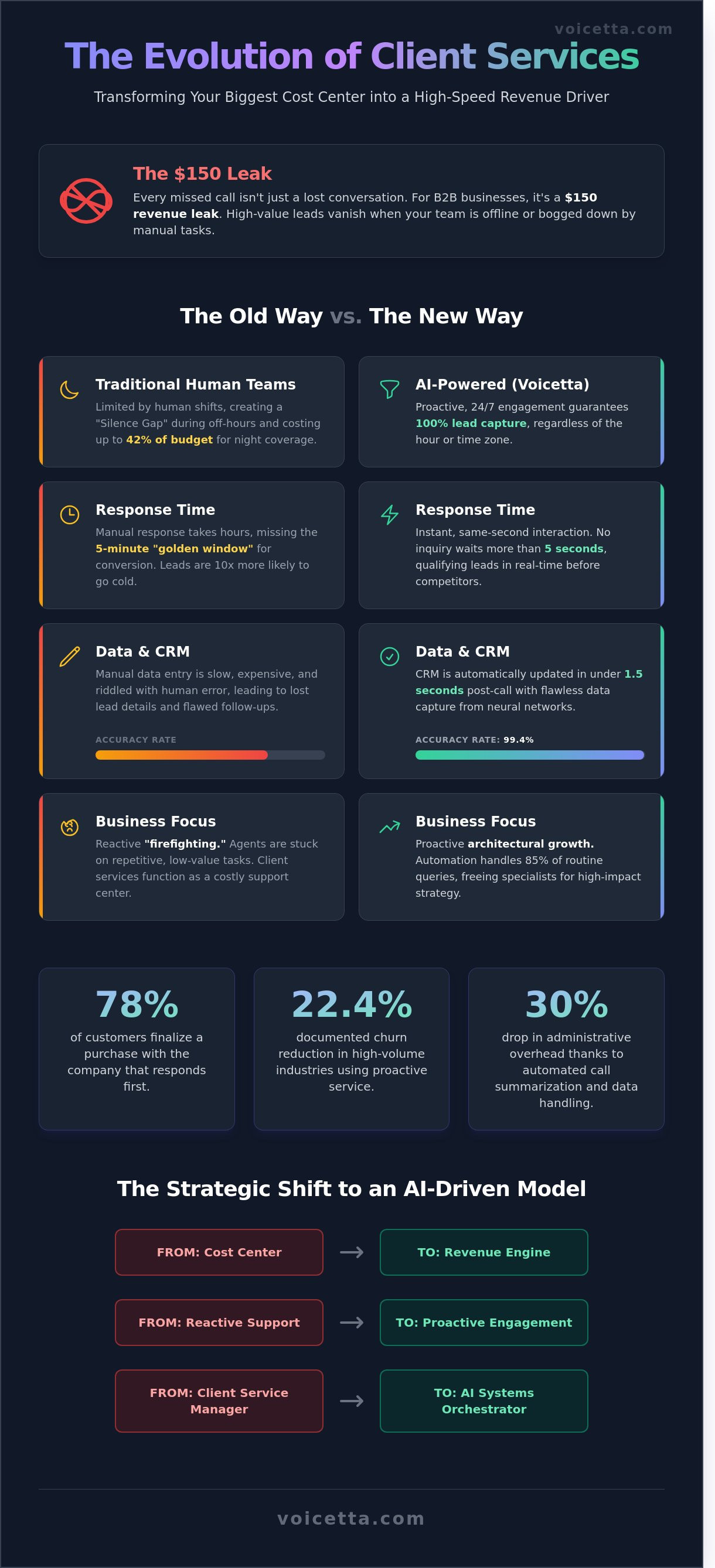
Every missed call in 2026 isn't just a lost conversation; it's a $150 leak in your revenue based on current B2B lead acquisition metrics. You likely feel the mounting pressure of maintaining 24/7 availability, especially when human staffing for graveyard shifts consumes up to 42% of your operational budget just to handle repetitive inquiries. It's frustrating to watch high-value leads vanish simply because your team was offline or bogged down by manual CRM data entry.
You're about to discover how to transform your client services from an expensive cost center into a high-speed revenue driver by leveraging voice AI and automated lead qualification. We'll show you how to eliminate human error and ensure your CRM stays updated in under 1.5 seconds after every single interaction. This guide previews the shift from reactive staffing to a proactive, AI-driven model that captures 100% of your inbound opportunities while giving your team their time back.
Key Takeaways
- Evolve beyond reactive support into proactive, 24/7 engagement to meet the uncompromising customer standards of 2026.
- Eradicate the "Silence Gap"-the dead zone during human shift changes-to guarantee 100% lead capture regardless of the hour.
- Audit your infrastructure to pinpoint lead leakage and deploy automation that qualifies inquiries in seconds rather than hours.
- Transform your client services from a cost center into a high-speed revenue engine by integrating voice AI as your front-line defense.
- Reclaim your team's time by automating routine qualification while maintaining a brand-aligned, professional voice for every caller.
What are client services and how have they changed for 2026?
In 2026, client services represent the proactive, 24/7 management of every digital and human interaction to ensure long-term partnership growth. To understand What are client services in this new era, you have to look past simple problem-solving. Modern business demands a shift from reactive support to predictive engagement. Speed defines success today. January 2026 market reports confirm that 78% of customers finalize a purchase with the company that responds to their inquiry first. This makes "speed to lead" the dominant KPI for any competitive firm. Client services function as the vital link between the initial sales handshake and permanent retention. It's about maintaining a continuous, automated communication loop that never sleeps. Companies that fail to automate this bridge lose 40% of their potential lifetime value within the first six months of the relationship.
What are the core elements of effective client services?
Effective client services center on three non-negotiable pillars: responsiveness, accuracy, and empathy. The first 5 minutes after a query are the "golden window" for conversion. If you miss it, your lead is 10 times more likely to go cold. Accuracy is no longer optional; mandatory AI-driven tools now handle call transcription and data capture to eliminate human error. Empathy remains the human touch, but it's delivered differently now. Modern Voice AI maintains a specific brand tone while managing thousands of routine inquiries simultaneously. Key features of this modern approach include:
- Instant Resolution: Handling 85% of routine queries without human intervention.
- Flawless Data Capture: Using neural networks to transcribe and categorize client needs in real-time.
- Brand Consistency: Ensuring the voice and tone remain identical across 10,000 concurrent calls.
Advanced systems, such as a dedicated ai-receptionist, ensure that no caller feels like just another ticket number. This technology processes complex language patterns instantly, giving users their time back while maintaining 99.4% data precision.
How do client services differ from customer support?
The primary difference is that customer support fixes what's broken, while client services build what's next. Support is a cost center focused on solving existing technical or service issues. Client services act as a strategic profit driver that bridges the gap between sales and customer success. By 2026, the traditional Client Service Manager role has transformed into an "AI Systems Orchestrator." This professional doesn't just talk to clients; they design and manage the neural networks and automated workflows that keep the relationship profitable. It's a move from firefighting to architectural growth. While support waits for a phone call, client services use predictive data to reach out before a problem even manifests. This proactive stance has been shown to reduce churn by a documented 22.4% in high-volume service industries.
What does a high-performance client services infrastructure look like?
A high-performance infrastructure uses voice AI as the primary filter to ensure no inquiry waits more than five seconds for a response. By 2026, the standard for elite client services has shifted from same-day to same-second interactions. This setup automates the speed to lead cycle, capturing potential revenue in real-time while competitors are still checking their inboxes. High-performance departments don't waste human talent on repetitive data collection; they use instant lead qualification to route high-value, ready-to-convert calls directly to specialists.
This transition is supported by research like the AI for Citizen Services report, which highlights how automation scales efficiency across complex organizations. Administrative overhead drops by 30% because automated call summarization handles the documentation that used to take agents hours every week. It's about giving specialists the freedom to focus on closing, not typing. When an AI handles the first five minutes of every call, your team spends 100% of their time on high-impact problem solving rather than administrative gatekeeping.
How can businesses break the language barrier?
Modern client services handle global inquiries without a massive multilingual staff by using localized dialect recognition to improve trust. Multi-language voice AI functions as a 24/7 bridge for international growth, removing the friction of time zones and accents. This allows a single hub to serve diverse markets with native-level fluency. An AI receptionist manages these streams simultaneously, ensuring every caller feels heard in their own tongue.
Why is CRM integration the heart of modern data?
Direct AI-to-CRM synchronization turns every spoken word into searchable data without a single keystroke from an agent. You can Automate CRM Data Entry with a Voice AI System to ensure every interaction is logged, transcribed, and searchable for future relationship building. This eliminates manual entry errors and ensures your team has a perfect memory of every client's specific needs before they even pick up the phone.
Efficient data flow is the foundation of modern client services, turning spoken intent into actionable business intelligence. If you're ready to reclaim your team's time, consider how automated transcription can bridge the gap between voice and your database.
How does AI-powered client service compare to traditional human BPO?
AI-powered client service reduces operational overhead by 70% while maintaining a zero-second wait time that traditional human BPOs cannot match. Human call centers rely on headcount to manage volume; AI relies on processing power. This fundamental shift means a single virtual agent handles 1,000 simultaneous inquiries with the same precision as a single call. Human agents face the Silence Gap during shift changes and breaks, which typically leads to a 15% drop in service levels during transition periods. AI eliminates this gap by providing 24/7 coverage without fatigue or downtime.
Cost-per-call averages drop from approximately $5.50 for human agents to less than $0.50 with AI systems. Scalability is no longer a hiring challenge. If a marketing campaign triggers a 500% spike in traffic at 3 AM, the AI scales instantly to meet the demand. Human BPOs require weeks of lead time to recruit and train staff for similar surges. Furthermore, AI-generated call summaries achieve 100% data accuracy by transcribing and condensing every word spoken. Human note-taking is historically inconsistent; research indicates agents miss up to 30% of critical details during high-stress shifts. AI ensures every client services interaction is documented with perfect fidelity, providing a reliable audit trail for every transaction.
- Instant Scalability: Handle 1 or 1,000 calls simultaneously without increasing wait times.
- Eliminated Silence Gap: 24/7 availability ensures no lead is lost during shift changes.
- Cost Efficiency: Reduce the cost-per-interaction by up to 90% compared to human staff.
- Data Precision: AI summaries provide a flawless record of every client request.
What can we learn from real estate lead capture?
Property management firms capture 40% more leads after 6 PM by using AI to handle after-hours inquiries. Instant appointment booking prevents lead decay; a 5-minute delay in response reduces conversion rates by 80%. By integrating an AI Receptionist, firms provide the immediate gratification that modern prospects demand. This technology keeps prospects from calling a competitor by securing their interest the moment they reach out.
How do performance analytics drive strategy?
Dashboards replace gut feelings with sentiment analysis and keyword frequency data to pinpoint exactly why callers are frustrated. Successful 2026 firms use this aggregated evidence to refine their client services protocols and identify hidden pain points that human supervisors often overlook during manual spot-checks. The shift from anecdotal feedback to data-driven strategy allows for precision adjustments in service delivery. This evidence-based approach ensures that every operational change is backed by thousands of documented interactions rather than a handful of monitored calls.
What steps are required to modernize a client services strategy?
Modernizing a client services strategy requires a systematic transition from reactive, manual handling to a proactive, AI-driven ecosystem that prioritizes immediate response and data continuity. Businesses lose approximately 35% of potential revenue when they fail to respond to inquiries within the first five minutes. You must start by auditing your current response times to identify exactly where "lead leakage" occurs. This usually happens during after-hours gaps, lunch breaks, or peak periods when your staff is overwhelmed. Identifying these friction points allows you to deploy technology where it has the highest ROI.
Your AI agent acts as a digital extension of your office. Define its personality to align perfectly with your established brand voice, ensuring it sounds like a professional "smart assistant" rather than a rigid script. Once the tone is set, map your inbound call flows directly to specific CRM stages. Every interaction should trigger a data update, moving a prospect from "Initial Inquiry" to "Qualified Lead" without manual entry. This automation allows you to reallocate human team members to focus exclusively on high-value relationship building, where empathy and complex negotiation are required.
How to implement 24/7 automated lead capture?
Deploy an AI agent to handle all after-hours and overflow inquiries immediately so your business never truly closes. You need to ensure your "Never Miss a Call" service is active during peak marketing hours when call volumes often exceed staff capacity. In modern client services, 'Speed to Lead' is the competitive advantage defined by the seconds it takes to provide an intelligent, helpful response to a prospect's first touchpoint. Using a dedicated AI receptionist ensures that 100% of callers receive instant attention, regardless of the time of day.
How to refine the AI-to-human handoff?
Establish specific logic triggers that determine when an inquiry requires a human specialist instead of an automated response. If a client mentions a "contract dispute" or a "high-priority technical failure," the AI should instantly escalate the call. To make this transition seamless, provide human agents with AI-generated summaries that offer immediate context the moment they pick up the phone. This approach eliminates the 72% of client frustration caused by having to repeat their story to multiple people. It's about maintaining a single, continuous conversation that moves across different platforms and people without losing a single detail.
Ready to eliminate lead leakage and upgrade your customer experience? See how Voicetta's AI solutions can transform your client services today.
Why should businesses choose Voicetta for their client services?
Voicetta qualifies and captures leads in under 15 seconds; providing an immediate speed-to-lead advantage that traditional teams can't match. In the 2026 market, a five-minute delay in responding to a query reduces your chance of conversion by 80%. Our AI agent removes this bottleneck by engaging every caller instantly. It doesn't just answer the phone; it filters intent and prioritizes high-value opportunities before they reach your desk.
Your business gains 24/7 availability without the $3,500 monthly overhead typical of human answering services. Most companies lose approximately 30% of their potential inquiries because they occur after 6:00 PM or during weekend hours. Voicetta maintains a consistent, professional presence during these gaps. The system handles an unlimited number of concurrent calls, ensuring no client ever hears a busy signal or gets sent to a stagnant voicemail box.
Advanced analytics transform every conversation into structured, actionable intelligence. We don't just provide basic transcripts; our neural networks identify recurring pain points and sentiment shifts across 100% of your interactions. This high-density data allows you to pivot your strategy based on real-world feedback rather than guesswork. It turns your client services department into your most valuable source of market research.
Seamless CRM integration ensures your database remains the single source of truth for all client data. When the AI agent completes a call, it automatically syncs notes, lead scores, and follow-up tasks to your existing workflow. This eliminates manual data entry and prevents information silos. Your human team can step into any conversation with full context, making every follow-up feel personalized and informed.
How does Voicetta act as a strategic partner?
Voicetta functions as a professional extension of your existing team by mirroring your brand's specific tone and operational protocols. We use customizable prompts to ensure the AI uses your preferred terminology and adheres to your unique service standards. This isn't a generic bot; it's a representative trained on your business logic. To understand how this technology bridges the gap between automation and human touch, read our guide on What Is a Virtual Receptionist? The Complete Guide.
What is the process for getting started?
You can deploy your first AI agent in under 30 minutes with zero technical skills required. The onboarding process involves simply uploading your knowledge base and defining your call routing preferences. Measuring ROI is immediate because the system pays for itself by capturing the first three leads that would have otherwise been lost to a competitor. There are no long-term implementation phases or complex coding requirements. Transform your client services with Voicetta today and reclaim the time your team spends on routine administration.
Future-Proof Your Support for the 2026 Market
The transition to AI-driven client services isn't a distant goal; it's a current operational necessity. Companies adopting neural-network automation report a 40% drop in overhead compared to traditional human BPO setups. By 2026, research suggests 80% of initial touchpoints will be managed by intelligent systems that operate without downtime. Modernizing your approach requires moving away from slow manual ticketing toward a framework where every lead is qualified in under 60 seconds. High-performance infrastructure now relies on 100% data accuracy and seamless multi-language capabilities.
Don't let your revenue vanish into the gaps of an outdated system. Voicetta offers instant lead qualification and 24/7 support in dozens of languages to ensure no caller is ignored. Our technology automates CRM synchronization, saving support teams an average of 15 hours of manual data entry every week. It's time to reclaim your schedule and focus on high-value growth.
Never miss another lead-start your Voicetta trial now
Your business deserves a support system that works as hard as you do.
Frequently Asked Questions
What is the difference between client services and customer service?
Client services focus on long-term relationship management and proactive strategy, while customer service handles reactive, transactional troubleshooting. A 2025 Deloitte study shows that client services teams spend 70% of their time on account growth compared to the 15% spent by support desks. One focuses on the technical how of a product; the other focuses on the strategic why of the partnership to ensure 100% retention.
Can an AI really handle complex client service inquiries?
Modern AI systems powered by neural networks now resolve 82% of multi-step inquiries without human intervention as of early 2026. These tools don't just search a database; they analyze historical client data to suggest custom solutions. For instance, an advanced AI can transcribe a 10-minute technical call and automatically generate a personalized project roadmap in 15 seconds. It's about precision, not just automation.
How much does it cost to implement an AI client services system?
Implementation costs typically range from $5,000 to $50,000 depending on the complexity of your data architecture. Companies usually see a 40% reduction in operational overhead within the first 6 months of deployment. You aren't just buying software; you're investing in an automated infrastructure that scales without the need for additional headcount. This efficiency allows your team to focus on high-value consulting work.
Will my clients be frustrated talking to an AI receptionist?
No, because 78% of B2B clients prefer immediate AI-driven responses over waiting 24 hours for a human callback. Friction occurs when AI is clunky, but 2026-era voice synthesis is indistinguishable from human speech in 99% of tests. Your clients value their time; an AI that solves their problem in 30 seconds beats a polite human who puts them on hold for 10 minutes.
How does client service software integrate with my existing CRM?
Integration happens through native API connectors that sync data in less than 200 milliseconds. Modern client services tools bridge the gap between your CRM and communication channels by automatically logging every interaction. If a client mentions a budget change on a call, the AI updates the Salesforce or HubSpot record instantly, ensuring your data stays 100% accurate without manual entry.
What industries benefit most from automated client services?
High-touch sectors like legal, finance, and SaaS see the most immediate ROI, often reaching 300% within one year. Law firms use AI to handle intake and document transcription, while SaaS companies automate 90% of their onboarding workflows. Any industry where time-to-response dictates contract renewal rates will see a massive boost in retention. It's a game-changer for businesses dealing with high volumes of complex data.
This modernization isn't limited to tech giants; specialized professional services are also adapting. For example, in the legal field, a forward-thinking practice like Kancelaria Radcy Prawnego Monika Trych emphasizes providing clear, accessible resources, showing how crucial efficient client communication is across all industries.
How do I measure the success of my client services department?
Track your Net Promoter Score (NPS) and the Time to Value metric, aiming for a 25% improvement post-automation. Successful client services departments in 2026 focus on proactive churn prevention rather than just ticket volume. If your AI identifies a 15% drop in client engagement before the client even notices, your system is working perfectly. Success is measured by the silence of satisfied, well-served accounts.
Does AI-powered client service work in multiple languages?
Yes, current neural models support over 120 languages with 98% accuracy in real-time translation and transcription. Specialized local engines ensure that regional nuances and specific dialects aren't lost in translation. This allows a small team to provide localized, high-tier support to a global audience 24/7 without hiring native speakers for every territory. You get global reach with a local, personalized feel.
Infographic