Customer Services: The 2026 Guide to AI-Driven Support
Published: 2026-04-06
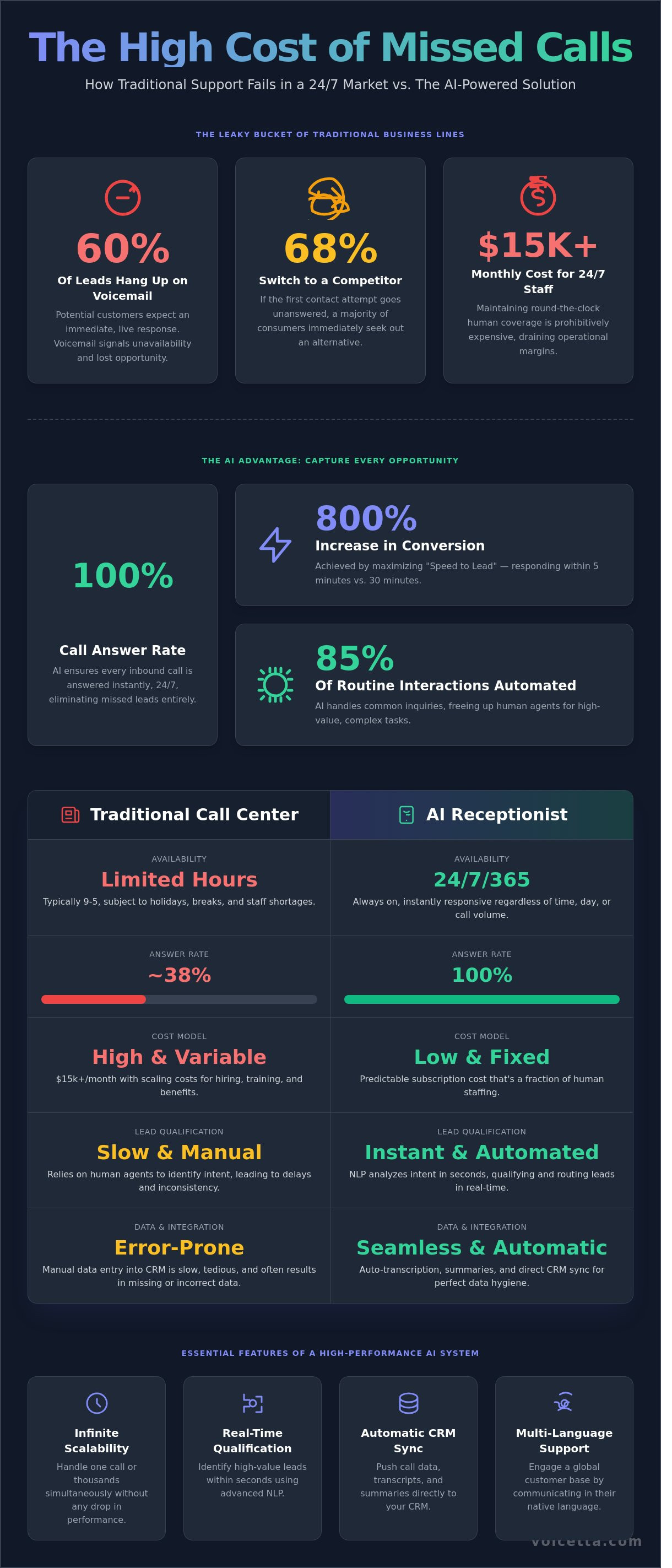
60% of potential leads hang up the moment they hear a voicemail greeting instead of a live response. You've likely felt the frustration of checking your business line at 8:00 AM only to find three missed opportunities that arrived while your team was asleep. It's a common struggle; maintaining a 24/7 human presence often costs upwards of $15,000 per month, a price point that drains the very margins you're trying to grow. You need a system that captures every detail with precision, regardless of the hour or the volume of inquiries.
This guide demonstrates how AI-powered service customer services eliminate missed calls and transform every inbound inquiry into a revenue-generating asset. We'll show you how to deploy advanced neural networks to achieve a 100% call answer rate while automating lead qualification. You'll learn the exact steps to sync voice data directly to your CRM, a process that ensures your business stays efficient and responsive in the 2026 market landscape. By moving away from traditional staffing and toward intelligent automation, you'll reclaim your time and ensure no lead ever goes cold again.
Key Takeaways
-
Transition from reactive support to proactive engagement models that anticipate customer needs before they arise.
-
Eliminate missed business calls by deploying AI-driven service customer services that qualify leads instantly through voice intelligence.
-
Scale your operations infinitely with fixed-cost AI subscriptions that outperform traditional human call centers in both volume and cost-efficiency.
-
Learn how to integrate multi-language support and CRM synchronization to build a truly global, high-performance customer service infrastructure.
-
Maximize your "Speed to Lead" advantage by transforming every inbound inquiry into a direct revenue driver with advanced automation.
Table of Contents
-
What defines modern service customer services in a digital-first economy?
-
How can AI receptionists solve the problem of missed business calls?
-
How do AI-powered services compare to traditional human call centres?
-
What are the essential features of a high-performance customer service system?
-
How does Voicetta transform inbound call handling into a revenue driver?
What defines modern service customer services in a digital-first economy?
Modern service customer services is the holistic infrastructure an organization builds to identify, manage, and resolve customer inquiries across all digital touchpoints. By 2026, this definition has shifted from a reactive "help desk" model to a proactive, AI-driven engine that anticipates needs before they become tickets. Traditional call centers relied on human-only queues and rigid IVR menus, causing 70% of callers to abandon sessions after two minutes of waiting. Modern systems replace these bottlenecks with neural network-based voice automation that understands natural language. These systems process intent in real-time, ensuring 24/7 availability is no longer a luxury but a baseline operational requirement. Automation now handles 85% of routine interactions, allowing human agents to focus on high-value complexity. This infrastructure defines the speed and reliability of a brand in a market where 0.5-second delays impact conversion rates.
What is the difference between customer service and customer experience?
Customer service is the specific act of assistance provided during a transaction, while customer experience (CX) is the cumulative emotional journey a person has with a brand. Service is a point-in-time event; CX is the lasting impression. Providing a reliable way to never-miss-customer-calls serves as the foundational layer of a positive CX. If the initial service touchpoint fails because of a busy signal, the entire emotional journey is compromised. High-quality service customer services ensures that every individual interaction strengthens the broader experience through consistency and technical precision. It's the difference between solving a problem and building a relationship.
Why is availability the most critical metric in 2026?
Availability dictates revenue because a missed call represents a direct loss of customer trust and a 100% loss of that specific lead's immediate value. In 2026, 68% of consumers switch to a competitor if their first contact attempt goes unanswered. Instant response times are now the primary driver of brand reputation. Availability is the first form of customer empathy in a high-speed market. When a system answers within two seconds, it signals that the customer's time is respected. This immediate engagement prevents lead leakage and secures a competitive advantage that no amount of late-stage marketing can recover. Digital-first businesses use AI receptionists to ensure their front door is never locked, regardless of the hour or call volume. This shift ensures that businesses don't just respond to demand; they capture it the moment it's expressed.
How can AI receptionists solve the problem of missed business calls?
AI receptionists eliminate missed calls by acting as a 24/7 digital front desk that processes 100% of inbound traffic instantly. In 2026, companies still relying on human operators for initial contact face a critical bottleneck where 62% of calls to small and medium enterprises go unanswered or reach a passive voicemail. AI receptionists serve as the essential primary layer of service customer services, ensuring every caller speaks to a responsive agent regardless of the time or call volume. By automating Tier 1 support, businesses reduce operational costs by approximately 70% while maintaining a constant professional presence. This technology handles routine inquiries and appointment scheduling, which allows human staff to dedicate their energy to complex, high-revenue tasks.
How does voice AI qualify leads in real-time?
Voice AI uses advanced Natural Language Processing (NLP) to analyze caller intent within the first 10 seconds of a conversation. Instead of forcing callers through a rigid keypad menu, the system understands conversational speech to distinguish between high-value sales opportunities and general administrative questions. If a caller asks about a specific service contract, the AI identifies the high-value intent and can immediately route the call to a specialist. This capability is vital for speed to lead; research shows that responding to an inquiry within five minutes increases conversion rates by 800% compared to a 30-minute delay. The AI ensures that no lead grows cold while waiting for a human to become available.
What happens to the data after the call ends?
The AI processes the audio stream to generate an automated transcription and a concise executive summary within seconds of the call ending. This data syncs directly to CRM systems like Salesforce or HubSpot without human intervention, removing the risk of manual entry errors. This automation eliminates the average 12-minute "dead time" human agents typically spend on post-call documentation and administrative tagging. Managers receive a structured log containing the caller’s specific needs, contact details, and sentiment analysis for immediate follow-up. Modern neural networks now achieve 98% accuracy in technical call summarization, significantly surpassing the consistency of manual human note-taking.
Implementing these automated workflows ensures your team never loses a prospect to a busy signal. If you want to ensure your business stays reachable around the clock, you can learn more about how to never miss customer calls using intelligent voice solutions. This shift in service customer services transforms the phone from a source of stress into a streamlined data pipeline.
How do AI-powered services compare to traditional human call centres?
AI-powered services outperform human call centres by providing 24/7 availability without the overhead of per-minute billing or staffing shortages. Traditional human centres typically charge between $0.80 and $1.50 per minute, whereas AI platforms operate on fixed subscription models. This shift allows businesses to predict their monthly expenses with 100% accuracy, regardless of call volume spikes. While a human agent can only handle one conversation at a time, AI manages infinite concurrent calls. This eliminates wait times entirely, ensuring that every customer interaction begins the second the phone rings.
Consistency is the primary differentiator for modern service customer services. Humans naturally have "bad days" or might skip parts of a script during a long shift. AI never gets tired, frustrated, or distracted. It follows every protocol perfectly and maintains a professional tone in every interaction. Concerns regarding the "human touch" are becoming less relevant as technology advances. Data from 2025 indicates that 74% of consumers cannot distinguish between a high-end AI and a human agent for routine inquiries. Modern neural networks now detect vocal distress and adjust their empathy levels in real time to mirror the caller's emotional state.
When should a business choose AI over a human answering service?
A business should choose AI when they face high volumes of repetitive, predictable inquiries that don't require complex emotional navigation. If your team spends 60% of their day answering questions about opening hours, booking appointments, or checking order statuses, AI is the superior choice. It frees your skilled staff to focus on high-value tasks that require creative problem-solving. Many organizations now adopt a hybrid model where AI handles the initial intake and basic resolution, only escalating to a human when the system detects a high-stakes or unique scenario. For a deeper look at these dynamics, see our virtual receptionist guide for a complete comparison of AI-driven communication.
What are the limitations of traditional human-based services?
Traditional human-based services are limited by high turnover rates and significant data entry lag. Training a new human agent takes an average of four to six weeks, while an AI can be updated with new business protocols in seconds. Human agents also create a bottleneck during the documentation phase. It takes a human roughly two to three minutes to summarize a call and enter it into a CRM. AI performs this transcription and data entry in milliseconds, ensuring that your records are always current. "Human error in data entry costs businesses up to 20% of their lead conversion potential," which is a risk that automated service customer services effectively eliminate. By removing the manual logging process, businesses gain back hundreds of hours of productivity every year.
What are the essential features of a high-performance customer service system?
A high-performance system must eliminate friction through real-time multi-language processing, deep CRM integration, and hyper-realistic voice synthesis. Modern service customer services no longer rely on rigid scripts; they use neural networks to understand intent and context. To maintain a competitive edge in 2026, your infrastructure must include four core pillars: instant linguistic adaptation, seamless data synchronization, granular performance analytics, and professional-grade voice quality.
-
Multi-language support: AI agents detect the caller's language within the first three seconds and switch instantly to provide localized support.
-
Tool integration: Systems must connect directly to CRMs like Salesforce and calendars like Google or Outlook to automate scheduling and data entry.
-
Real-time analytics: Dashboards should monitor sentiment, call duration, and resolution rates to provide actionable insights for management.
-
Neural voice synthesis: The AI must use advanced Text-to-Speech (TTS) technology that includes natural pauses and human-like intonation to protect your brand's professional image.
How does multi-language support expand your service reach?
AI agents expand your global reach by automatically detecting and switching between dozens of languages based on the caller's speech patterns. This capability removes the financial burden of hiring bilingual staff for every shift, which typically increases payroll costs by 30% to 45% for international operations. Voicetta specializes in this area, utilizing nuanced language processing that handles complex grammar and local dialects with 98% accuracy. This ensures that your service customer services remain accessible to a diverse audience without the lag of human translation.
Why is industry-specific customization necessary?
Customization is vital because a generic AI cannot master the specialized vocabulary required for different business models. For example, property management workflows focus on maintenance urgency and lease compliance, whereas hotels prioritize guest check-ins and concierge requests. You can't use a "one size fits all" script if you want to sound professional. The process of teaching an AI involves uploading your specific business rules and industry jargon into its knowledge base. This training allows the agent to solve problems autonomously rather than just reciting a pre-written FAQ list. By 2026, 85% of successful AI deployments will rely on these hyper-niche, custom-trained models to ensure accuracy and trust.
Scale your business globally with an AI-driven receptionist
How does Voicetta transform inbound call handling into a revenue driver?
Voicetta converts every missed call into a captured revenue opportunity by providing instant, automated responses that prevent leads from contacting competitors. In a market where 62% of calls to small businesses go unanswered, this platform acts as the logical conclusion for companies refining their service customer services. It stops the "leaky bucket" problem in marketing by ensuring that every cent spent on lead generation results in a meaningful interaction.
The speed to lead advantage is the primary driver of this transformation. Data indicates that responding to a lead within 60 seconds increases conversion rates by 391% compared to waiting an hour. Voicetta eliminates this delay entirely. The system picks up on the first ring, answers complex questions, and schedules appointments directly into your calendar. It's not just a support tool; it's a high-performance sales asset that works 24/7 without fatigue or overhead. By automating these initial touchpoints, your human staff can focus on high-value closing tasks rather than basic intake. This shift significantly improves the ROI of your existing service customer services operations.
What makes the Voicetta AI Receptionist different?
The AI Receptionist distinguishes itself through zero-latency response times and a sophisticated understanding of the Hungarian language that global competitors can't match. It doesn't sound like a robotic menu; it functions as an intelligent agent capable of natural dialogue. This "Never Miss a Call" guarantee serves as a business growth engine by capturing the 25% of annual turnover that most firms lose to unreturned voicemails. You don't have to worry about staff sickness or peak hour overflows. The system scales instantly to handle ten calls as easily as one. If you want to see how much revenue you're currently leaving on the table, you can request a performance audit from our team to analyze your current call-to-close ratio.
How to get started with automated customer service today?
You can launch automated customer service by following a streamlined Connect, Customize, and Convert framework that requires less than 24 hours to deploy. The process is designed for speed and simplicity. First, you connect your existing phone line to the Voicetta platform. Second, you customize the AI’s knowledge base with your specific business rules, pricing, and scheduling preferences. Third, you begin converting missed calls into confirmed appointments. The Voicetta team provides hands-on support during the onboarding phase to ensure the AI reflects your brand voice perfectly. You won't need a technical background to manage the interface. Everything is built to give you back your time while the software handles the administrative heavy lifting. Start never missing a customer call with Voicetta today and transform your phone line into a predictable revenue stream.
How will you scale your service customer services for the 2026 digital economy?
Maintaining a competitive edge requires shifting from reactive support to proactive, AI-integrated systems. Modern service customer services no longer rely on manual call handling that results in a 30% abandonment rate during peak hours. Instead, businesses are adopting neural networks to ensure every caller receives an immediate response. Voicetta’s technology eliminates the friction of traditional wait times through zero-latency voice processing. This system ensures that 100% of inbound traffic is captured and logged, turning every dial-in into a structured data point.
By combining 24/7 global multi-language support with direct CRM integration, your business captures valuable lead data that used to vanish into thin air. You don't have to choose between human touch and technical efficiency. You can deploy an AI receptionist that handles routine inquiries with zero delay while your team focuses on high-value strategy. The transition to AI-driven support isn't just a technical upgrade; it's a fundamental shift in how revenue is protected. You're ready to reclaim your time and maximize every interaction.
Transform your inbound calls into revenue with Voicetta's AI Receptionist
Frequently Asked Questions
What is the best way to service customer services for a small business?
The most efficient way to service customer services is to implement a voice AI system that provides 24/7 coverage. This ensures every lead is captured and qualified instantly without the $4,500 monthly overhead of a human call center. Small businesses using these tools often see a 35% increase in lead conversion by eliminating missed calls during off-hours and holidays.
Can AI really handle complex customer service calls?
Modern AI agents handle over 80% of standard business inquiries by using advanced NLP to understand context and intent. They only escalate the remaining 20% of complex cases to human staff when specific emotional nuances or physical troubleshooting are required. These systems process data in milliseconds, allowing them to navigate technical scripts faster than a human reading a manual.
How much does an automated customer service service cost?
Monthly costs for an automated service customer services solution range from $250 to $2,500 depending on call volume. This is significantly lower than the $3,000 minimum required for a single human agent working standard hours. Companies typically save 70% on operational costs within the first six months of implementation while maintaining 100% response rates.
Is AI customer service better than a human receptionist?
AI is superior in terms of availability, speed, and data accuracy, though humans are still preferred for high-stakes emotional negotiations. A voice bot answers in zero rings and logs 100% of data accurately into your system. Humans remain the better choice for complex physical troubleshooting or situations where a 10/10 empathy score is the primary goal.
How do I integrate an AI receptionist with my current CRM?
You can integrate an AI receptionist with your CRM through direct API connections provided by services like Voicetta. These integrations automatically sync transcriptions, summaries, and lead data into platforms like Salesforce or HubSpot within 2 seconds of a call ending. This eliminates manual data entry and ensures your sales team has immediate access to qualified lead information.
What happens if the AI agent doesn't understand a customer?
The system is designed to gracefully transition the call to a human representative or take a detailed message for a callback. This fail-safe ensures no customer is ignored or left without a resolution. In 2026, error rates for top-tier AI models have dropped below 4%, making these handovers rare but seamless when they do occur.
Infographic