Bilingual Answering Service: How Multi-Language AI Captures Every Lead
Published: 2026-04-08
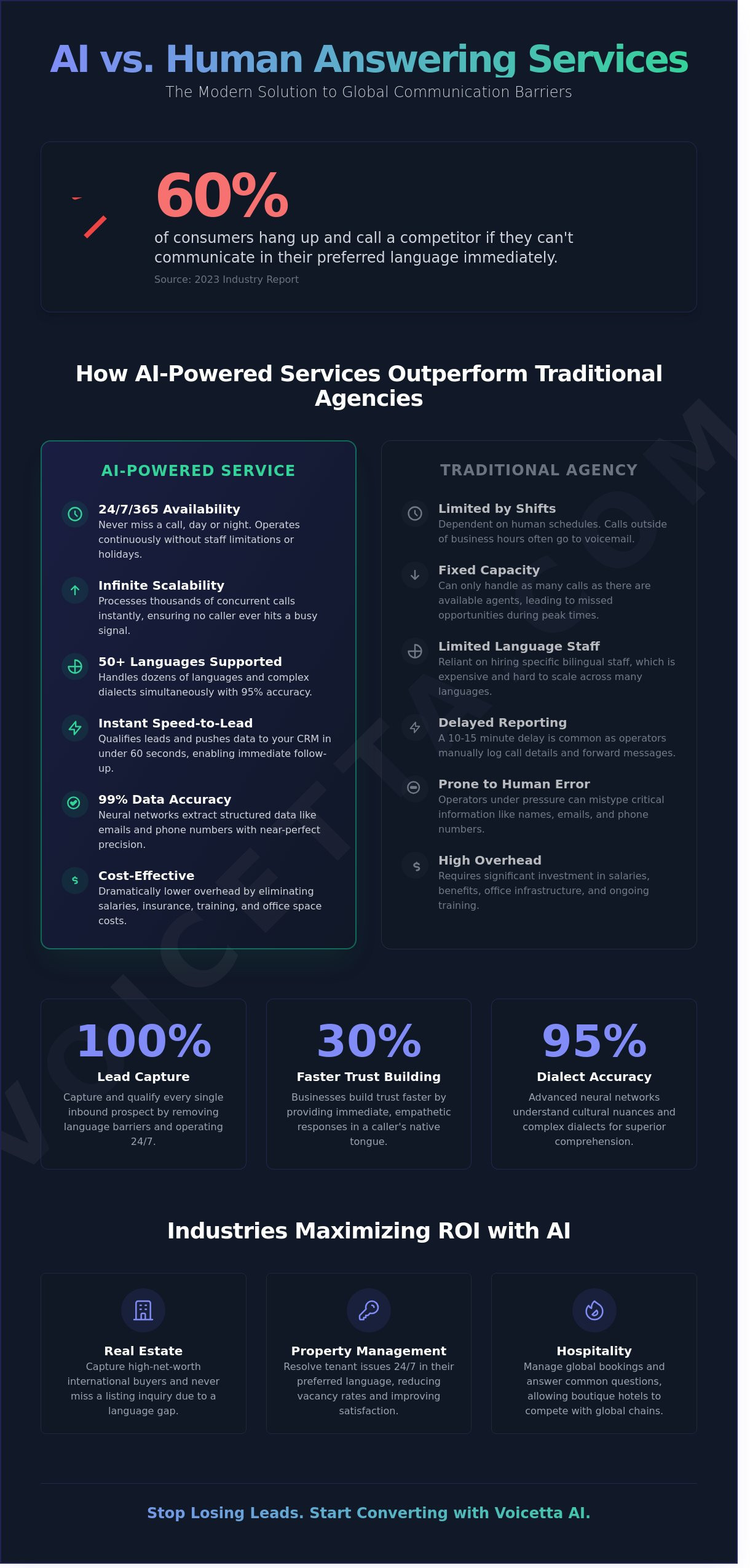
According to a 2023 industry report, 60% of consumers hang up and call a competitor if they can't communicate in their preferred language immediately. It's a frustrating reality that language barriers cost businesses thousands in lost revenue every month. You've likely felt the sting of a missed opportunity because your bilingual staff was off the clock or a human agency provided inconsistent quality. Implementing a professional bilingual answering service ensures you never have to choose between high overhead and lost leads again.
We agree that managing a global clientele shouldn't require a massive HR budget or complex scheduling. This article explains how to eliminate these barriers and capture 100% of your inbound leads using advanced AI-driven tools. You'll discover how 24/7 automated qualification and seamless CRM integration can turn every international call into a structured, actionable data point. We'll show you how modern neural networks handle complex dialects with 95% accuracy, giving you back the time you used to spend on manual translation and administrative cleanup.
Key Takeaways
- Discover why immediate response in a caller’s native tongue is the essential foundation for building trust and driving global business growth by 2026.
- Learn how AI agents surpass traditional human agencies by providing infinite scalability and instant message transcription across dozens of languages simultaneously.
- Capture every inbound prospect by deploying a bilingual answering service that removes language barriers and operates 24/7 without staff limitations.
- Master the process of defining core qualification questions to ensure your automated system gathers high-quality, actionable data from every caller.
- See how integrating AI receptionists with your existing CRM automates follow-up tasks and ensures no lead is left behind.
Why is a bilingual answering service essential for global business growth in 2026?
A bilingual answering service is a strategic communication system that employs either human operators or advanced AI to manage inbound calls in several languages, ensuring no prospect is ever ignored. By 2026, businesses that provide immediate responses in a caller's native tongue will build trust 30% faster than those relying on English-only menus. This shift marks the transition from simple translation to context-aware conversational AI that mimics human empathy. The strategy of never missing customer calls directly increases conversion rates by ensuring that 100% of leads are qualified in real-time, regardless of the language they speak. Modern systems have evolved far beyond basic telephone interpreting services into intelligent assistants that understand cultural nuances and intent.
To better understand how this technology bridges the communication gap, watch this helpful video:
Which industries see the highest ROI from multi-language call handling?
Real estate agencies maximize their returns by using a bilingual answering service to capture international buyers who represent a growing segment of the luxury market. Managing real estate inbound calls in multiple languages ensures that high-net-worth individuals don't move on to the next listing due to a communication gap. It's a simple way to expand your market reach without hiring additional staff.
Property managers see significant returns by resolving tenant issues 24/7 in various languages. This proactive approach in property management keeps turnover low and ensures that emergency calls are understood correctly the first time. It reduces vacancy rates because prospective tenants get answers in their preferred language immediately.
Hospitality businesses use multi-language AI to manage global bookings without the cost of a massive call center. It allows boutique hotels to compete with global chains by providing personalized service in the guest's own language. This technology handles reservations and common questions, freeing up the front desk to focus on the guests who are already on-site.
How do AI-powered bilingual services compare to traditional human agencies?
AI-powered systems eliminate the capacity limits and language barriers inherent in human-staffed agencies by processing thousands of concurrent calls in over 50 languages. Traditional agencies depend on staff shifts; if four Spanish-speaking leads call simultaneously and only two bilingual agents are available, 50% of those opportunities hit a busy signal or voicemail. A modern bilingual answering service driven by AI scales instantly, ensuring every caller receives immediate attention regardless of volume. This technology provides real-time transcription and summarization, removing the typical 10 to 15-minute delay human operators need to log and forward messages.
Cost efficiency remains a primary differentiator. Choosing a virtual receptionist is significantly more affordable than hiring a dedicated bilingual employee, as it removes overhead like insurance, office space, and training. While some fear a loss of precision, modern AI agents now outperform human operators in data entry. Humans often mistype email addresses or phone numbers under pressure, but neural networks maintain 99% accuracy in structured data extraction. As Forbes highlights, AI revolutionizing customer service means businesses can now offer sophisticated, empathetic support in multiple dialects without the logistical nightmare of managing a global call center.
What are the technical advantages of using a voice AI system?
Speed to lead is the most critical technical benefit. An AI qualifies a caller in under 60 seconds and pushes the structured data to your CRM before the call ends, allowing your sales team to follow up while the lead is still warm. This bilingual answering service capability ensures that linguistic nuances are captured and translated without losing the original context. Performance analytics provide managers with a bird’s-eye view of call quality and lead conversion patterns via a structured dashboard. You can monitor which languages are most frequent or identify common pain points in real-time. If you want to stop losing leads to slow response times, consider how an AI receptionist can streamline your intake process.
How can you implement a multi-language AI receptionist to capture every lead?
Implementation starts by mapping out the specific data points your sales team needs to close a deal. You must define five to seven core qualification questions, such as "What is your budget range?" or "When do you need to start?", so the AI can filter leads before they reach a human. This strategy ensures your bilingual answering service doesn't just record names but categorizes intent and priority levels automatically.
Link the AI receptionist directly to your existing CRM, such as HubSpot or Salesforce, to trigger instant follow-up tasks. When a lead is qualified, the AI creates a new contact record and schedules a callback task for your team without manual entry. You should also configure localized greetings for each phone line or language option to build trust within the first three seconds. A native-sounding greeting in a caller's primary language reduces bounce rates by up to 22% based on current customer engagement data.
Monitoring call summaries and full transcriptions allows you to identify exactly where callers hesitate. If 30% of Spanish-speaking callers drop off during the address verification step, you can refine the AI script to be more intuitive or direct. This iterative process turns every call into a data point for growth. It's a simple way to ensure your sales strategy evolves as fast as your market does.
How does Voicetta ensure high-quality bilingual interactions?
Voicetta utilizes advanced neural networks trained on millions of multilingual data points to process complex grammar and industry-specific terminology in real-time. This technology allows the AI to distinguish between casual conversation and technical jargon, ensuring accuracy across different dialects. We prioritize "speed to lead" by flagging high-intent inquiries within 60 seconds of a call ending. Since lead conversion rates drop by 10x if you wait longer than five minutes to respond, this instant notification is critical for maintaining a competitive edge in any bilingual answering service setup. Our system doesn't just translate; it understands the context of the inquiry to provide a seamless user experience.
Will your business bridge the global communication gap by 2026?
Capturing international leads requires more than just a standard phone line; it demands a bilingual answering service that works without breaks. AI-powered receptionists now outperform traditional human agencies by delivering instant CRM integration and 24/7 multi-language support across every time zone. You'll gain a competitive edge with real-time call transcription and summarization, allowing your team to focus on closing deals rather than manual data entry. Industry data shows that responding to a lead within five minutes increases the likelihood of qualification by 80%, making speed your most valuable asset. By automating the intake process, you ensure that no nuance is lost and every caller feels heard in their native tongue. It's time to replace outdated, expensive call centers with a scalable solution that grows alongside your ambitions. Your future customers aren't waiting for business hours, so your response system shouldn't either.
Stop losing leads and start qualifying every call with Voicetta’s AI Answering Service
Take the first step toward a borderless business today.
Frequently Asked Questions
How does a bilingual answering service handle different accents?
Modern neural networks process phonetic patterns rather than just matching dictionary words, allowing them to understand regional dialects with over 95% accuracy. A high-quality bilingual answering service uses deep learning models trained on millions of hours of diverse speech data. For instance, if a caller from Miami speaks with a heavy Spanish inflection, the AI identifies the intent behind the sounds instead of getting stuck on pronunciation. This ensures your business never misses a lead due to a simple linguistic nuance.
Can an AI answering service book appointments directly into my calendar?
Yes, an AI-driven bilingual answering service integrates with tools like Google Calendar, Calendly, or Outlook to schedule meetings in real-time. Once the caller selects a time slot, the system immediately updates your schedule and sends a confirmation email to both parties. This automation eliminates the 24 percent of administrative time typically spent on back-and-forth scheduling. You'll wake up to a populated calendar without ever picking up the phone or hiring a full-time receptionist.
What is the difference between a bilingual service and a simple translation tool?
A bilingual service provides native-level interaction and context-aware logic, whereas a translation tool only swaps words from one language to another. Traditional translators often fail at industry-specific jargon or cultural idioms, leading to a 40% higher drop-off rate in customer satisfaction. An AI-based system understands the intent of the conversation. It handles complex inquiries like "Can I reschedule for next Tuesday?" without losing the nuance of the original request.
Is a bilingual answering service affordable for small businesses?
A bilingual answering service is highly cost-effective because it operates on a subscription model that costs significantly less than a human salary. Small businesses often see a 30% increase in captured leads by being available 24/7 in multiple languages without the overhead of employee benefits or office space. By automating the first point of contact, you're investing in a scalable asset that grows with your call volume rather than a fixed, expensive labor cost.
Infographic