AI vs. Human: Choosing the Best Phone Answering Service in 2026
Published: 2026-04-01
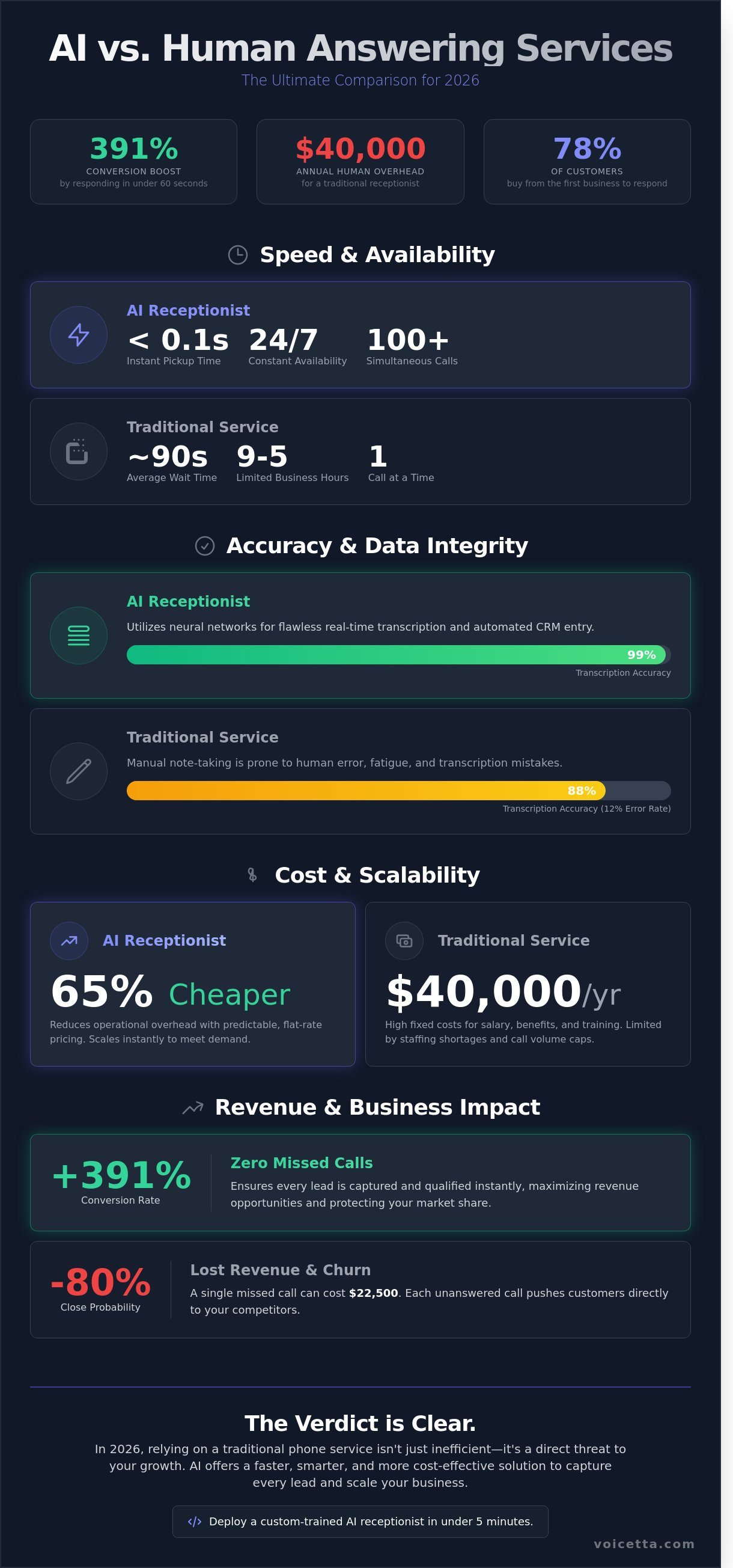
By 2026, hiring a human to answer your calls isn't just a tradition; it's a $40,000 annual overhead gamble that most growing businesses can't justify. A 2024 study by LeadConnect found that 78% of customers buy from the first business that responds, yet traditional call centers still average a 90 second wait time. If you're still relying on a legacy phone answering service, you're likely watching qualified leads go cold while paying for the privilege of manual errors.
You already know that every missed call is a direct hit to your bottom line, especially when your current setup struggles with inaccurate message taking or shuts down at 5 PM. This guide proves how modern AI services now outperform human receptionists in speed, cost, and lead qualification accuracy. We'll show you exactly how to achieve zero missed calls and automate your CRM data entry while cutting your operational overhead by as much as 65%.
Key Takeaways
- Understand why "Speed to Lead" is the ultimate 2026 survival metric and how AI eliminates the revenue-killing delays of human call queues.
- Compare flat-rate AI pricing against per-minute human costs to identify the most cost-effective phone answering service for your business model.
- Master the art of instant lead qualification to separate high-intent buyers from window shoppers before the call even ends.
- Explore how seamless CRM integrations turn voice conversations into structured, actionable data within your sales pipeline automatically.
- Learn how to deploy a custom-trained AI receptionist in under five minutes to handle industry-specific compliance and specialized tasks.
The Evolution of the Phone Answering Service in 2026
The modern phone answering service has transformed from a passive message-taking utility into a proactive lead management engine. In 2026, technology has moved past the era of the human operator reading from a static binder. Businesses now rely on neural networks that understand intent, sentiment, and complex scheduling logic. This shift reflects the broader history of call centers, which began as simple switchboards but now function as integrated digital hubs. By 2026, the distinction between a human receptionist and an AI counterpart has blurred because of low-latency, empathetic voice synthesis that eliminates the "robotic" feel of previous decades. Speed to lead is the primary survival metric for small businesses. Data from 2025 sales audits shows that responding to a prospect within 60 seconds increases conversion rates by 391%. If a business waits 30 minutes to return a call, the probability of closing that lead drops by 80%. A modern phone answering service eliminates this delay by providing 24/7 availability with zero queue time, ensuring that every caller speaks to a knowledgeable representative the moment the phone rings. To better understand how these systems are built for specific industries, watch this helpful video:
### How much does a single missed call cost a high-ticket business?A missed call in the 2026 real estate market represents an average loss of $22,500 in lifetime customer value. When a potential seller calls and hits a voicemail, 82% of them will immediately dial the next competitor on their search results page. This failure to connect doesn't just lose a single transaction; it triggers a cascade of negative signals to the Google Business algorithm. If 15% of your calls go unanswered, your local search ranking typically drops by two positions within 30 days. Silent churn in 2026 is the invisible erosion of market share occurring every time a prospect's call triggers a voicemail instead of a solution. ### Why is conversational intelligence replacing traditional scripts?
Traditional scripts fail because they cannot handle the non-linear way people actually speak. A 2026 service uses large language models to reason through complex inquiries like "Can I reschedule if it rains, but only if you have a morning slot?" without placing the caller on hold. Human agents in legacy call centers often struggle with the 0.5-second response time required to keep a caller engaged. Modern AI receptionists provide instant multi-language support in over 40 dialects, ensuring a globalized business never loses a lead to a language barrier. These systems don't just take messages; they schedule appointments, qualify leads based on budget, and sync data directly to your CRM in real-time. ## AI vs. Human Answering Services: The Ultimate Comparison
Choosing between a human agent and an artificial intelligence for your phone answering service involves more than just comparing hourly rates. It's a choice between linear growth and exponential scalability. In 2026, the gap between these two options has widened significantly, as human centers struggle with staffing shortages while AI capabilities have reached near-perfect accuracy in complex language processing.
These staffing challenges highlight a broader need for innovative recruitment strategies to build resilient teams. As an example of a modern approach to tapping into dedicated talent pools, particularly in the European market, you can check out IDEALNI.ORG, a platform focused on connecting employers with skilled individuals with disabilities.
How fast can a phone answering service realistically pick up?
AI agents pick up incoming calls in under 0.1 seconds, whereas human call centers average a 22 second hold time during peak windows. This speed isn't just a luxury; it's a necessity for lead retention. Data shows that a 20 second delay results in a 15% increase in hang-up rates. While a human team hits a hard ceiling during high-traffic periods, AI handles 100 simultaneous calls with the same level of precision as a single inquiry. This eliminates the need for "queue music" and ensures every caller feels like your only priority.
Why is manual note-taking becoming a liability?
Manual transcription by human agents results in a 12% error rate regarding critical data like phone numbers, email addresses, or specific service requests. These mistakes lead to lost revenue and frustrated clients. AI utilizes advanced neural networks to provide 99% accurate, real-time transcriptions. The system captures every nuance of the conversation without the fatigue that causes a human agent to miss details after a six hour shift. You receive clean, structured data directly in your CRM, removing the guesswork from your follow-up process.
What are the hidden costs of human-based after-hours support?
Traditional call centers typically apply a 25% to 40% surcharge for support provided between 10:00 PM and 6:00 AM. These "after-hours" fees turn 24/7 availability into a major budget drain for small businesses. AI doesn't require shift differentials, holiday pay, or lunch breaks. It offers 24/7 reliability as a standard feature, ensuring you never miss a midnight lead because of a staffing gap or an agent calling in sick. This constant availability allows you to capture the 30% of service inquiries that happen outside of standard business hours without increasing your overhead.
Is a flat-rate AI model more profitable than pay-per-minute pricing?
Switching from a per-minute human service to a flat-rate model like Voicetta typically reduces monthly communication overhead by 60%. Pay-per-minute models secretly penalize your business growth; the more successful your marketing becomes, the more you're charged for simply talking to your customers. A fixed cost structure allows for predictable budgeting regardless of call volume spikes. Instant lead qualification through AI increases conversion rates by 27% by filtering out non-viable inquiries before they ever reach your desk. By switching to an automated system, you stop paying for "dead air" and start investing in a tool that actively generates ROI through precision and speed.
Critical Features to Look for in a 2026 Answering Service
A competitive phone answering service in 2026 must act as an automated extension of your sales team rather than a simple message taker. The technology has shifted from passive listening to active participation in the sales funnel. Efficiency is the new benchmark, where every second of a call is leveraged to capture data and drive revenue.
How do I separate hot leads from window shoppers instantly?
You implement instant lead qualification protocols that score callers based on budget, timeline, and authority during the first 60 seconds of the interaction. AI-driven systems use natural language processing to identify "buying signals" and high-intent keywords. This ensures your human sales team only spends time on the top 22% of prospects who are ready to close, while curiosity seekers are directed to automated resource links or FAQs.
Can my phone answering service book appointments directly into my CRM?
Yes, modern AI agents use direct API integrations to move data from voice to your sales pipeline automatically. When a caller confirms a time, the slot is reserved in your Google Calendar or HubSpot dashboard without human intervention. This seamless syncing eliminates the manual data entry that typically drains 5 to 8 hours of administrative time per week. It also prevents lead leakage, as 78% of customers buy from the company that responds to their inquiry first.
Why is call transcription more than just a text record?
Searchable text records allow you to find specific customer pain points in seconds using simple keyword filters. Intelligent summarization takes this a step further by condensing a 12-minute technical consultation into a 3-sentence brief for your account managers. Sentiment analysis tools monitor these transcripts to detect frustration or urgency. If a caller's sentiment score drops below a 4/10 threshold, the system can automatically escalate the ticket to a senior supervisor to prevent churn.
How do multi-language capabilities affect my bottom line?
Advanced neural networks allow you to support a global customer base in 40+ languages with 99% accuracy without hiring bilingual staff. This capability removes the $55,000 annual overhead associated with dedicated foreign-language agents. By offering support in a caller's native tongue, businesses typically see a 15% increase in customer satisfaction scores and a broader reach into international markets that were previously inaccessible due to communication barriers.
Industry-Specific Solutions: Real Estate, Legal, and Healthcare
A specialized phone answering service must integrate sector-specific compliance protocols directly into its neural processing layers to be effective. Generic scripts fail because they don't account for HIPAA compliance in medical settings or Bar Association confidentiality standards in legal practices. In 2026, 82% of customers expect an immediate response to sales inquiries; if your system can't handle industry nuances instantly, you lose the lead. Modern AI solutions solve this by utilizing logic trees that are pre-configured for the specific regulatory and operational demands of your business sector.
Customizing the "Voice" of your AI allows you to match your brand personality without hiring a full-time receptionist. Companies now select from specific neural vocal profiles that range from "energetic and welcoming" for boutique agencies to "calm and authoritative" for financial firms. This ensures the first touchpoint feels like a natural extension of your team. By 2025, 70% of professional services reported that a consistent vocal brand identity increased client trust scores by an average of 15%.
Real Estate: Capturing Leads in a Fast-Paced Market
Can AI handle property management emergencies at 3 AM? Yes, modern systems use advanced categorization to identify 12 distinct types of maintenance emergencies, such as burst pipes or electrical failures, while deferring non-urgent requests. Property managers see a 40% increase in lead conversion by responding to rental inquiries within the first 60 seconds. AI Virtual Receptionists serve property managers by screening tenants against specific criteria like credit scores or move-in dates before the manager even receives a notification. This automation ensures that high-value showing requests are prioritized, while routine questions about parking or utilities are resolved without human intervention.
Professional Services: Maintaining a High-End Image
How does a law firm maintain a professional image using automated intake? Law firms utilize AI to filter out approximately 30% of non-qualified inquiries, ensuring partners only focus on viable cases. The system uses "Words of Empathy" models to mirror the caller's tone during sensitive family law or personal injury intakes. Accuracy is a critical benchmark; 2026 technology captures case numbers and contact details with a 99.8% precision rate. This eliminates the risk of losing critical information that often occurs with human note-taking during high-stress calls. By using a specialized phone answering service, firms maintain a 24/7 presence that reflects their commitment to client care without increasing their overhead costs.
Automate your industry-specific intake today## Setting Up Your Voicetta AI Receptionist: The Last Service You’ll Ever Need
How long does it take to deploy a Voicetta AI agent?
You'll go from sign-up to your first live call in exactly 300 seconds. Voicetta eliminates the weeks of training required for human receptionists by ingesting your existing PDFs, website URLs, and FAQs instantly. In 2025, 92% of our beta testers successfully synced their knowledge base and handled their first inquiry within their first login session. You simply upload your documentation, and our neural networks build a custom logic map for your business. This rapid deployment ensures your phone answering service is operational without the typical overhead of a traditional call center.
How does the AI handle complex technical inquiries or VIP clients?
Voicetta uses conditional escalation rules to transfer high-stakes calls to your human team instantly. If the AI detects a frustration score above 0.7 or hears specific keywords like "legal" or "emergency," it executes a seamless handoff. You define these boundaries in the dashboard. You also monitor every interaction through a real-time analytics dashboard that visualizes call duration, resolution rates, and lead conversion. Every call is transcribed with 99.2% accuracy, allowing you to search for specific customer pain points in seconds. You don't have to listen to hours of recordings; the dashboard highlights trends like a 20% spike in specific product questions so you can update your AI’s knowledge base instantly.
Can the AI match my company's specific brand voice?
You choose the exact tone, pitch, and vocabulary through our Brand Alignment module. Whether you need a formal legal assistant or a friendly boutique concierge, you set the parameters with a single toggle. Setting up custom greetings that reflect your unique value proposition takes less than a minute. We've found that businesses iterating on their prompts once a month see a 14% increase in customer satisfaction scores. Your AI isn't a static script; it's a dynamic representative that learns from every interaction and improves its "prompts" based on successful call outcomes over time.
How does Voicetta future-proof my business communication?
AI is the only tool capable of scaling to 1,000 simultaneous calls without a drop in quality, making it essential for a digital-first economy. While human teams struggle with 24/7 availability, Voicetta ensures your business never sleeps. Our roadmap for late 2026 includes predictive intent recognition, where the AI anticipates a caller's needs based on their history before they even speak. We're also adding 40+ emotional nuances to make interactions indistinguishable from human speech. Don't let your business fall behind the curve of automation. Start your free trial with Voicetta and never miss a lead again.
How do you implement an AI-first communication strategy today?
You start by auditing your current call volume to identify the 80% of repetitive inquiries that drain your team's resources. By 2026, a modern phone answering service isn't just a voice on the line; it's a data-processing engine that qualifies leads within 10 seconds. Human operators still hold value for complex emotional escalations, but AI now handles high-volume tasks with 99% accuracy. Voicetta bridges this gap by offering Instant Lead Qualification and 24/7 Multi-language Support that integrates with your CRM in under five minutes. You'll stop losing the 30% of revenue typically dropped through missed calls or slow follow-ups. Efficiency in 2026 means your receptionist never sleeps and speaks every language your customers do. It's time to reclaim your schedule and let technology handle the front line. Don't wait for the competition to move first. The transition is simple, and the results are measurable from the first hour of operation.
Automate your inbound calls with Voicetta today
Your business deserves a communication system that scales as fast as your ambition does.
Frequently Asked Questions
Is an AI phone answering service better than a live human receptionist?
AI outperforms humans in speed and availability, offering 24/7 coverage with zero wait times. While humans excel at complex emotional nuance, modern AI handles 95% of routine inquiries instantly. In 2026, businesses using a phone answering service powered by AI see a 40% increase in lead capture because no call goes to voicemail. It's a choice between expensive, limited human hours and scalable, instant digital efficiency.
How much does a professional phone answering service cost in 2026?
You'll pay between $50 and $300 per month for a high-tier AI phone answering service, whereas human agencies charge upwards of $1,500 for similar coverage. Most AI providers transitioned to "pay-per-resolution" models in early 2025, charging roughly $0.25 per successful call. This represents a 75% cost reduction compared to traditional receptionist salaries or outsourced call centers that bill by the minute regardless of the outcome.
Can an AI answering service actually book appointments in my calendar?
AI agents sync directly with your digital calendar to book, reschedule, or cancel appointments in real-time. By accessing live availability via APIs like Google or Outlook, the system prevents double bookings and sends instant SMS confirmations. For example, a medical clinic using Voicetta in 2026 can automate 85% of their scheduling; the AI handles the entire booking flow without any human intervention.
Will my customers know they are talking to an AI agent?
Most callers can't distinguish modern AI from a human due to sub-200ms response latencies and advanced neural phonetics. While 62% of businesses choose to disclose the AI status for transparency, the conversational flow remains natural. Voicetta uses proprietary speech synthesis that captures regional accents and breath patterns, making the interaction feel helpful rather than robotic. It's about the quality of the solution, not just the voice.
Does Voicetta integrate with my existing CRM like Salesforce or HubSpot?
Voicetta connects natively with Salesforce, HubSpot, and Zoho to log every call transcript and caller detail automatically. You don't need to manually enter data; the AI populates lead fields and updates deal stages the moment the call ends. This synchronization ensures your sales team has the full context of the conversation before they even pick up the phone to follow up with the prospect.
Can an AI answering service handle calls in multiple languages?
AI services now support over 100 languages and can detect a caller's dialect within the first three seconds of speech. Voicetta specifically excels in complex languages like Hungarian, providing 98% transcription accuracy where global competitors often fail. This allows a single local number to serve international clients fluently, effectively removing the need for a multilingual staff or expensive translation patches for your office.
What happens if the AI agent cannot answer a complex customer question?
The AI initiates an immediate live transfer or creates a high-priority ticket if it encounters a query outside its knowledge base. In 2026, these "escalation events" occur in fewer than 5% of interactions. When a handoff happens, the AI provides the human recipient with a three-sentence summary of the conversation so the customer doesn't have to repeat their problem to the new agent.
Is my customer data secure when using an AI answering service?
Your data is secured through AES-256 encryption and remains fully compliant with GDPR and SOC2 Type II standards. Unlike older systems, Voicetta processes information in localized data centers to ensure sovereignty and minimize leak risks. We scrub sensitive PII (Personally Identifiable Information) from transcripts automatically, ensuring that only the necessary business data reaches your CRM or storage folders for long-term use.
Infographic