AI Phone Agent Reliability: How to Ensure Your Virtual Receptionist Never Misses a Beat
Published: 2026-04-13
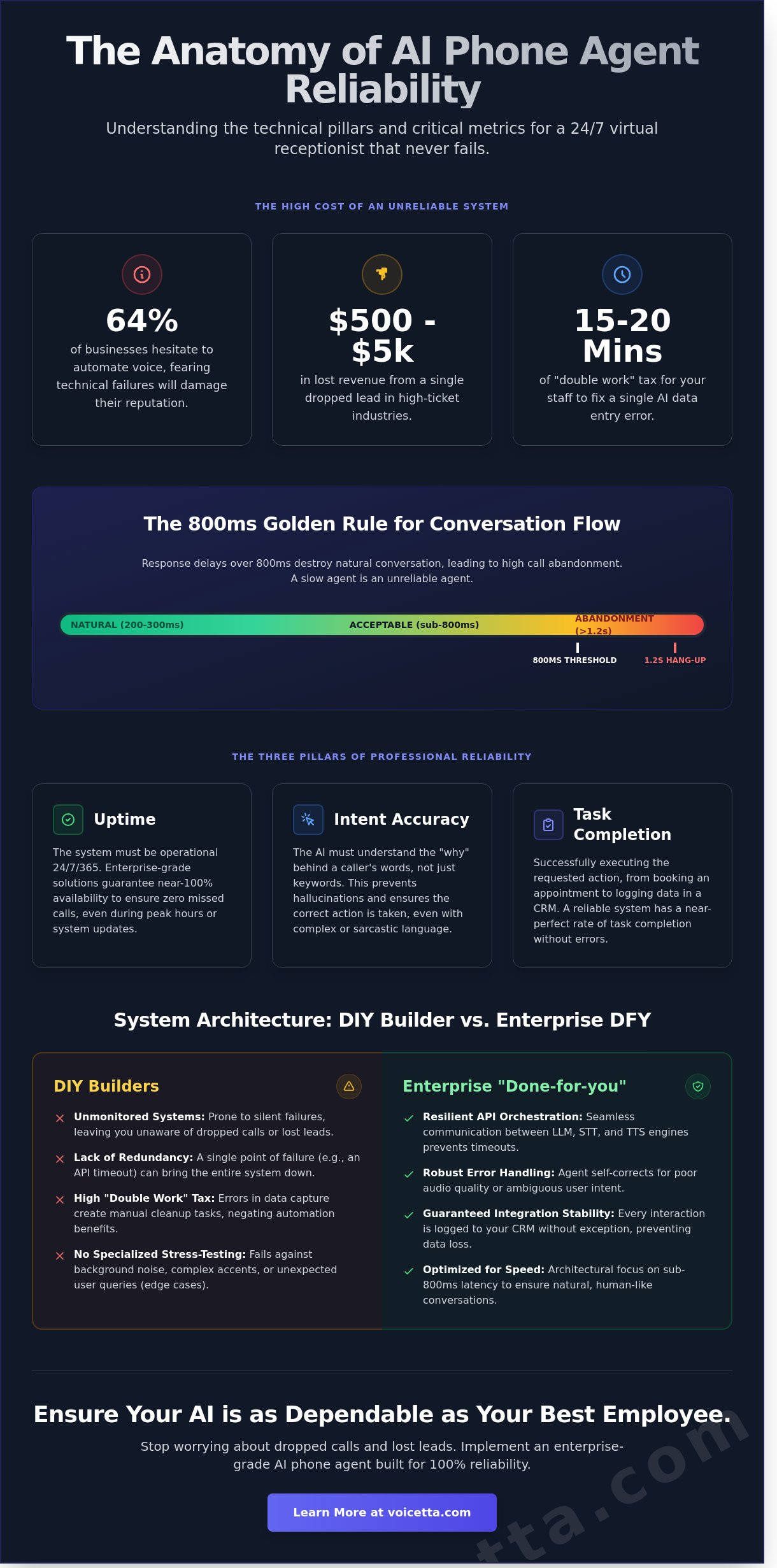
If your virtual receptionist takes more than 1.2 seconds to respond, your caller has already mentally checked out of the conversation. It's a harsh reality, but in 2026, ai phone agent reliability isn't just about answering the phone; it's about sub-second latency and zero hallucination rates. You likely feel that nagging anxiety every time a high-value lead calls, wondering if the AI will invent a fake service or fail to log the data in your CRM. You aren't alone. Industry benchmarks from late 2025 show that 64% of businesses hesitate to automate voice because they fear technical failures will damage their reputation.
You've worked hard to build your brand, so you deserve a 24/7 answering solution that's as dependable as your best human employee. This article provides the technical pillars and practical benchmarks you need to evaluate a truly resilient system. We'll show you how to ensure zero missed calls and seamless data logging through advanced neural networks. You'll learn the exact metrics, from jitter buffers to context window management, that guarantee your virtual assistant never misses a beat or a lead.
Key Takeaways
- Define professional reliability through the three non-negotiable metrics: uptime, intent accuracy, and task completion rates.
- Understand why the 800ms latency threshold is the "golden rule" for maintaining natural conversation flow and preventing technical friction.
- Learn how to implement specific stress-testing benchmarks to verify ai phone agent reliability against background noise and complex edge cases.
- Evaluate the critical stability and redundancy benefits of enterprise-grade "Done-for-you" systems compared to unmonitored DIY builders.
What does AI phone agent reliability actually mean for your business?
AI phone agent reliability is the measurable ability of a voice system to understand a caller's intent and execute the requested task without technical failure. It isn't a vague feeling of "working well"; it's a technical baseline defined by three specific metrics: uptime, intent accuracy, and task completion rate. A reliable system ensures that a Voice User Interface (VUI) processes human speech with the same precision as a trained employee.
To better understand the technical frameworks that ensure these systems stay operational, watch this helpful video:
Reliability serves as a [never-miss-customer-calls](https://voicetta.com) safety net. When a system lacks this stability, businesses face brand erosion. This happens when awkward four-second pauses or incorrect data delivery frustrate callers. In a 2024 industry survey, 60% of customers stated they would hang up if an automated system failed to understand them twice. High reliability eliminates these friction points, keeping your brand's reputation intact while you sleep.What is the cost of an unreliable phone system in 2026?
A single dropped lead in high-ticket industries like real estate or legal services can cost between $500 and $5,000 in immediate lost revenue. By 2026, as AI becomes the standard for first-contact interactions, customers won't tolerate technical glitches. If an agent fails to book a viewing or log a support ticket, that potential revenue vanishes instantly. Reliability ensures these high-value opportunities aren't lost to a server timeout or a logic error.
Sloppy AI agents also create a "double work" tax for your human staff. When an agent captures incorrect phone numbers or misunderstands a service request, a human employee must spend 15 to 20 minutes fixing the error. This negates the efficiency gains of automation. A reliable agent delivers clean, actionable data, allowing your team to focus on closing deals rather than cleaning up digital messes. Ensuring your ai phone agent reliability stays high is the only way to scale without increasing your administrative overhead.
What are the core technical pillars of a stable voice AI system?
Stability in voice AI isn't a single feature but the result of four synchronized technical foundations. Maintaining high ai phone agent reliability requires a system where every component, from the ear to the brain to the voice, operates with perfect timing. A failure in any one of these pillars results in dropped calls or frustrated customers.
- Sub-800ms Latency: Response times must stay under this threshold to mimic natural human speech patterns.
- Resilient API Orchestration: Seamless communication between the LLM, STT, and TTS engines prevents system timeouts during peak hours.
- Robust Error Handling: The agent must possess the logic to self-correct when it encounters poor audio quality or ambiguous intent.
- Integration Stability: Every interaction must be logged to your CRM without exception to prevent data loss.
Why is sub-second latency the most critical factor for ai phone agent reliability?
Response delays exceeding 800ms destroy the illusion of human interaction and lead to "clobbering," where the caller and agent speak at the same time. Human conversations typically feature gaps of only 200 to 300 milliseconds. When an agent takes longer than one second to respond, the caller usually assumes the system has crashed or isn't listening, leading to high abandonment rates.
Voicetta optimizes the Vapi and Retell stacks to keep these response times within the human-like range. This technical precision ensures your ai-receptionist maintains a professional pace that feels indistinguishable from a live staff member. We prioritize speed at the architectural level because a slow agent is an unreliable agent.
How does intent accuracy prevent hallucinations during complex calls?
Reliable agents identify the "why" behind a caller's words through context rather than just matching literal keywords to a database. Simple keyword matching fails when a customer uses sarcasm, complex sentence structures, or changes their mind mid-sentence. High-tier reliability depends on prompt engineering that sets strict guardrails, preventing the agent from making things up or "hallucinating" incorrect information when it's unsure.
If the Speech-to-Text engine produces a garbled sentence due to background noise, the system uses context-aware logic to infer the correct meaning and continue the conversation. Integration stability then ensures every captured intent is synced to your CRM immediately. If you want to see how this technical framework handles your specific industry needs, you can explore our common questions section for deeper insights.
How can you measure AI phone agent reliability before deployment?
You measure AI phone agent reliability by subjecting the system to "stress tests" that mimic real-world chaos, such as heavy background noise and non-linear dialogue. Testing in a silent room doesn't reflect the reality of your customers' lives. You should simulate environments with at least 60dB of background noise, like a busy coffee shop or a windy street, to verify the Speech-to-Text (STT) engine's resilience. If the transcription accuracy drops below 95% in these conditions, the agent will likely frustrate your callers and provide poor data.
Reliability also depends on how the AI handles "edge cases" or circular logic. Don't just follow the script during your internal testing. Interrupt the agent. Ask a question about parking in the middle of a booking flow, then immediately jump back to the original topic. A reliable agent maintains context across these shifts without looping or crashing. You must also audit your integration logs. Confirm that 100% of test data, including names and intent, successfully populates your CRM. Even a 1% data loss rate can lead to dozens of missed opportunities every month.
Finally, look at the infrastructure supporting the software. Request uptime reports and a documented redundancy plan from the service provider. A professional provider should guarantee at least 99.9% uptime. This ensures that if one server cluster fails, another takes over instantly without the caller ever noticing a glitch.
The 5-point reliability test for new agents
Business owners can vet their AI by following this specific sequence before going live:
- Noise Resilience: Play street noise recordings at high volume while speaking to the agent to test phonetic recognition.
- Accent Variation: Have people with different regional accents call the system to ensure the ai phone agent reliability remains consistent across demographics.
- Logic Interruption: Ask two unrelated questions in quick succession to test the system's "context switching" capabilities.
- CRM Sync: Verify that every piece of captured information appears in your database within 60 seconds of the call ending.
- Provider Audit: Review the provider's SLA (Service Level Agreement) to confirm they have failover protocols in place.
For more detailed answers on technical benchmarks and performance standards, you can visit our questions page to see common reliability FAQs. If you're ready to upgrade your customer experience with a system built for precision, it's time to ensure you never miss customer calls again.
Why is a 'Done-for-you' system more reliable than a DIY builder?
Managed AI systems provide ai phone agent reliability by replacing generic templates with enterprise-grade infrastructure. While DIY tools offer a low barrier to entry, they lack the redundant architecture required to handle high call volumes without failure. A professional deployment includes continuous performance tuning and multi-layered monitoring that catches errors before they reach your customers.
Enterprise setups utilize multiple redundant APIs to ensure the system stays online. If a primary speech-to-text provider experiences a 500ms lag, a managed system instantly reroutes the data through a secondary path. This prevents the "dead air" or dropped calls common in basic builders. Additionally, custom call-flows are designed to account for thousands of edge cases, such as background noise or callers who change their minds mid-sentence, which generic builders typically ignore.
Managed services also incorporate "human-in-the-loop" quality assurance. Experts review call transcripts to refine the AI's logic, ensuring the system learns from complex interactions. This iterative process transforms the AI from a simple script-reader into a sophisticated brand representative that improves every week.
Is a DIY tool or an enterprise-grade system better for stability?
Enterprise-grade systems are significantly more stable because they don't rely on a single point of failure. Drag-and-drop builders are often limited by the stability of the one platform they're built on. Voicetta handles the monitoring and reliability layer by integrating custom-coded fail-safes that DIY tools can't replicate. We manage the technical stack so you don't have to worry about API outages or latency spikes. It's the difference between a hobbyist project and a robust business tool that guarantees 99.9% uptime.
Why is reliability critical for Real Estate and Hotels?
Reliability is mission-critical in these sectors because a missed call directly equals lost revenue. For real estate inbound calls, an AI that fails to capture a lead's phone number accurately can cost a broker a five-figure commission. In hotels, precision is the priority. Structured data capture eliminates booking errors by validating dates and guest counts in real-time. By connecting the AI directly to property management systems, we've seen booking accuracy rates reach 100%, removing the human error that often plagues manual data entry.
How do you move from a prototype to a reliable voice AI strategy?
Building a voice system is easy, but maintaining enterprise-grade ai phone agent reliability requires specific technical foundations. True reliability means more than just answering the phone; it's about sub-800ms average latency to ensure natural conversation flow. Stability is non-negotiable, which is why Voicetta backs enterprise deployments with a 99.9% uptime guarantee. This level of precision ensures your virtual receptionist is always ready when your customers need assistance.
Choosing a "Done-for-you" system eliminates the risks inherent in DIY builders. It provides seamless, professional integration with tools you already use, like HubSpot and Salesforce, without the technical debt of custom coding. Measuring these metrics before your first customer calls ensures your brand's reputation remains intact and your operations remain efficient. You'll save hours of manual administration while providing a world-class caller experience every time the phone rings.
Don't leave your customer experience to chance. Stop worrying about missed calls or laggy responses and start scaling your operations with confidence. Book a reliability audit for your inbound calls with Voicetta to see how your current system stacks up. Your business deserves a partner that values precision and human-centric technology as much as you do.
Frequently Asked Questions
Is AI phone agent reliability better than a human answering service?
AI phone agent reliability is superior to human services because software doesn't experience fatigue, illness, or distractions. While a human receptionist might miss 2% of calls during high-traffic shifts, an AI agent answers every ring instantly and provides 100% availability. It delivers consistent, high-quality responses 24/7 without the variability of human mood or energy levels.
What happens if the AI agent encounters an 'edge case' it wasn't programmed for?
The system triggers a pre-defined fallback protocol to ensure the customer journey never hits a dead end. Instead of failing, the AI offers to schedule a callback or transfers the call to a human specialist for complex resolution. This ensures that even unique or unexpected requests result in a documented ticket rather than a frustrated caller.
How does latency affect the reliability of a voice AI conversation?
Low latency is the foundation of ai phone agent reliability, as response times must stay under 500 milliseconds to maintain a natural pace. If the system lags for more than a second, the conversation becomes disjointed and the caller's trust drops. We use optimized neural networks to process speech in near real-time, which keeps the dialogue as fluid as a standard phone call.
Can an AI phone agent handle multiple calls simultaneously without crashing?
Yes, AI agents handle unlimited simultaneous calls by utilizing cloud-based scaling that physical offices can't match. A single virtual infrastructure can manage 500 concurrent conversations as easily as one. This prevents the "busy signal" issue that affects 15% of callers in traditional business environments, ensuring every customer gets immediate attention.
What security measures ensure the reliability and safety of customer data?
Data reliability is maintained through AES-256 end-to-end encryption and strict adherence to GDPR standards for every interaction. All voice data is processed through secure layers where sensitive information can be automatically redacted. This ensures that customer data stays protected while providing a seamless, professional service experience.
Infographic