AI Answering Service vs. Human: Which Handles Business Calls Better in 2026?
Published: 2026-05-06
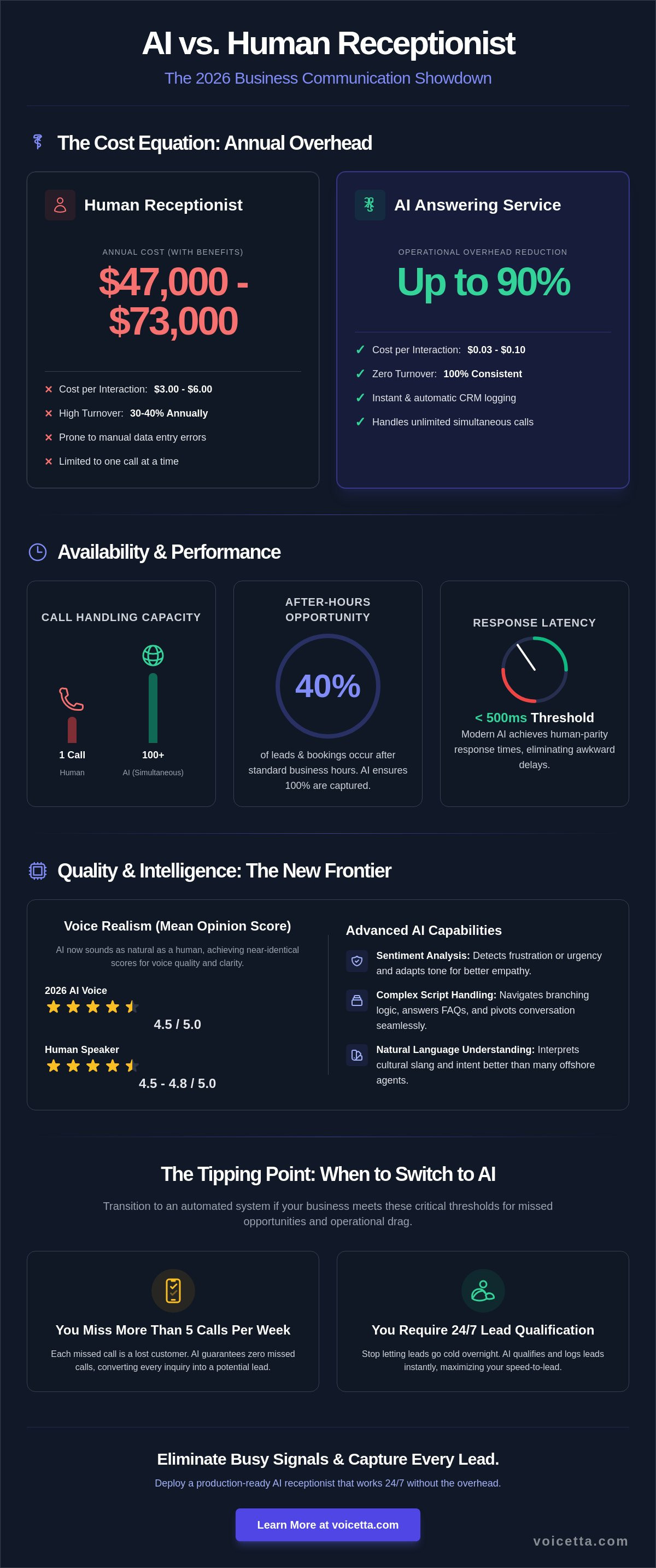
Hiring a full-time human receptionist in 2026 costs between $47,000 and $73,000 annually, while an ai answering service vs human comparison reveals that AI interactions now cost as little as $0.03 per call. You've likely seen 40% of your customer inquiries arrive after you've closed for the day, which means you're losing revenue every night your phones go silent. Maintaining a 24/7 human team is an expensive, inconsistent burden that often leads to manual data errors and missed opportunities when leads go cold.
You deserve a communication system that works as hard as you do without the 30% turnover rate of traditional call centers. This article reveals the objective differences in speed, cost, and quality between human agents and AI receptionists to help you optimize your 2026 strategy. You'll learn how to achieve zero missed calls and instant CRM logging while reducing your overhead by up to 80%. We'll show you why the latest voice technology makes AI nearly indistinguishable from human staff, giving you the freedom to focus on growth instead of playing phone tag.
Key Takeaways
- AI answering services eliminate busy signals by handling unlimited simultaneous calls while cutting operational overhead by up to 90%.
- Current neural models achieve response times under 500ms, meaning the ai answering service vs human choice now centers on data accuracy rather than voice quality.
- Transition to an automated system if your business misses more than five calls per week or requires 24/7 lead qualification.
- Deploy a production-ready system that manages complex scripts and CRM logging automatically to remove the burden of manual data entry.
Table of Contents
- How does the cost and capacity of an AI answering service compare to human agents?
- Is 2026 voice AI realistic enough to replace a human receptionist?
- When should a business choose AI over a traditional call center?
- Why is Voicetta’s 'Done-for-you' system better than traditional outsourcing?
How does the cost and capacity of an AI answering service compare to human agents?
AI answering services reduce operational costs by 70-90% compared to 24/7 human staffing. A single human receptionist in 2026 costs between $47,000 and $73,000 annually once you include benefits, payroll taxes, and equipment. In contrast, AI agents handle 100 simultaneous calls without wait times or busy signals. This provides infinite capacity that no human team can realistically match. While a traditional automated attendant simply routes calls to different departments, modern AI handles the entire interaction from the first ring to the final CRM entry.
To better understand how this technology bridges the gap between efficiency and a human touch, watch this helpful video:
### What are the hidden costs of human-based answering services?Human services carry a 30-40% annual turnover rate, which forces your business into a constant, expensive cycle of recruitment and retraining. You're also paying for "idle time" where staff sit waiting for the phone to ring. Traditional call centers often charge between $3.00 and $6.00 per interaction, whereas an ai answering service vs human cost analysis shows AI sessions as low as $0.10. AI removes management overhead because the system is production-ready the moment it's deployed.
How does 24/7 availability impact lead conversion rates?
Capture 100% of your leads by staying open while your competitors are asleep. Verified data shows 40% of bookings happen after standard business hours, representing a massive revenue gap for companies without 24/7 coverage. AI maximizes your speed-to-lead by qualifying callers the moment they dial, ensuring no lead goes cold. You can explore the full impact of this strategy in our guide on 24/7 call answering and response. By choosing an ai answering service vs human agents, you guarantee that every caller receives an immediate, helpful response regardless of the time of day.
Is 2026 voice AI realistic enough to replace a human receptionist?
Modern voice AI has reached a Mean Opinion Score (MOS) of 4.5 out of 5, placing it on par with the average human speaker's score of 4.5 to 4.8. Unlike the robotic, disjointed voices of 2023, 2026 neural models simulate natural breathing patterns and perfect prosody. This means the ai answering service vs human debate is no longer about who sounds more "real" but about who captures data more accurately. Advanced conversational AI technology now allows agents to detect frustration or urgency in a caller's voice. When sentiment analysis flags a distressed customer, the system immediately shifts its tone to be more empathetic, ensuring the caller feels heard and understood.
Why is sub-500ms latency the human-parity threshold?
Latency is the defining factor for realism in 2026. Humans process speech and respond in approximately 500ms; if a bot takes longer, the conversation feels disjointed and awkward. Older bots suffered from 2-second delays that broke the flow of dialogue. Current systems built on Vapi or Retell achieve response times well under this 500ms threshold. This removes the "uncanny valley" effect, making the interaction feel like a standard phone call rather than a struggle with a machine.
Can AI handle complex scripts and emotional callers?
Current AI interprets cultural slang and intent better than many offshore human agents. It doesn't just read a script; it understands context and handles logic jumps with ease. This allows for sophisticated call flow design and optimization where the agent can pivot between booking an appointment and answering a technical FAQ mid-sentence. If a caller changes their mind halfway through a sentence, the AI adapts instantly without requiring a restart. You can see this high-level logic in action by exploring our AI receptionist solutions. These systems don't just follow a path; they navigate the conversation to reach your business goals every time.
When should a business choose AI over a traditional call center?
Switch to an AI system if your business consistently misses more than five calls per week or requires 24/7 coverage without the high overhead of human shifts. The ai answering service vs human decision boils down to the nature of your interactions. If your primary goal is lead qualification or automated appointment booking, AI delivers an immediate ROI. Research from Dartmouth College on the economic benefits of automation suggests that while human roles are evolving, the efficiency gains in high-volume environments are undeniable. Businesses that implement a "never miss" policy see a direct correlation with revenue growth because they capture leads the moment they dial.
Which industries benefit most from automated call handling?
Real estate and property management companies experience the fastest transformation. These sectors handle high-volume, repetitive inquiries where 80% of callers ask the same five questions about pricing, availability, or location. By automating real estate inbound calls, agents can filter out window shoppers and only speak with qualified buyers. This ensures your human team spends 100% of their time on high-value negotiations rather than basic data entry. If you want to stop losing leads to slow response times, you can never miss customer calls again by deploying a production-ready agent today.
When is a human agent still the superior choice?
Human agents remain the preferred choice for high-stakes crisis counseling or complex legal advice where emotional nuance is the primary product. When evaluating an ai answering service vs human for these specific roles, the customer often pays for human empathy. However, even these businesses usually adopt a hybrid model. AI handles the initial intake and qualification, while humans step in to close high-ticket deals or handle sensitive edge cases. This balance protects your brand's reputation while maximizing operational efficiency. Ready to see how this fits your workflow? Explore our done-for-you AI call handling systems to start converting every dial into structured data.
Why is Voicetta’s 'Done-for-you' system better than traditional outsourcing?
Voicetta provides a fully managed production system that handles every stage of call logic, script optimization, and edge-case management for you. Traditional outsourcing to human call centers relies on manual note-taking and inconsistent agent performance. In the ai answering service vs human comparison, human agents can't match the precision of an AI that logs every interaction as structured data. We handle the enterprise-grade setup using advanced APIs like Vapi and Retell, ensuring your system is reliable from day one without requiring you to hire an in-house engineer. This removes the technical debt and management burden typically associated with scaling a communication team.
How does direct CRM integration transform call data into revenue?
Structured data allows you to trigger instant marketing automations the moment a call ends. When a human takes a message, you often receive a vague email summary hours later. With crm integration and data logging, every call becomes a set of tags, appointment dates, and qualified lead scores. Your system can instantly sync with HubSpot or Salesforce to send a follow-up SMS, cutting your speed-to-lead to zero seconds. This ensures that every qualified lead is pushed through your sales funnel without manual intervention.
What is the difference between a production-ready system and a DIY tool?
DIY tools provide a blank canvas that requires you to build your own logic; Voicetta delivers a finished, optimized product. Most platforms force you to troubleshoot API errors and design complex scripts yourself. We provide a full ai phone agent deployment that includes continuous monitoring and weekly performance tuning based on real call data. This hands-off approach is the most efficient way to win the ai answering service vs human battle for your business. You can see how Voicetta builds your custom AI receptionist to handle your specific inbound call flow end-to-end.
Scale your business with 24/7 automated call handling
The gap in the ai answering service vs human debate has officially closed. It's no longer a question of whether a machine sounds real; it's a question of whether your business can afford to lose the 40% of leads that arrive after hours. By implementing sub-500ms latency technology, you provide a natural conversation experience that captures every caller's intent on the first ring. Unlike traditional call centers, these systems turn audio into structured data, logging appointments directly into HubSpot or Salesforce without manual entry errors.
Voicetta's system ensures you get a production-ready agent with 100% custom call flow design included. You'll gain the freedom to focus on high-ticket negotiations while your AI handles the repetitive qualifying and scheduling. Every inbound call becomes a documented opportunity for growth rather than a missed notification on a silent phone. Start qualifying every lead 24/7 with a Voicetta AI Receptionist and take control of your communication strategy today.
Frequently Asked Questions
Will my customers know they are talking to an AI?
Most customers won't distinguish the AI from a human because 2026 neural models achieve sub-500ms latency and high voice realism. Top-ranked tools like ElevenLabs reach a Mean Opinion Score of 4.5 out of 5, which matches typical human speakers. You can choose to be transparent or let the natural timing and breathing patterns of the AI handle the conversation seamlessly without the caller ever noticing a difference.
How much cheaper is an AI answering service compared to a human agency?
An AI answering service is typically 87% to 97% less expensive than hiring a full-time human receptionist. While a human agent's fully loaded cost can reach $110,000 annually, AI agents operate at $0.03 to $0.50 per interaction. This massive price gap in the ai answering service vs human comparison allows you to reinvest thousands of dollars back into your marketing budget every month.
Can the AI answering service book appointments directly into my calendar?
Yes, the system integrates directly with tools like Calendly, Google Calendar, or custom CRMs to book appointments in real-time. The AI qualifies the lead first by asking your specific screening questions, then offers available time slots based on your live availability. This eliminates the back-and-forth emails usually required when human receptionists just take a message and wait for you to call back.
What happens if the AI cannot answer a specific question?
The AI uses pre-defined handoff logic to either transfer the call to a human team member or log a specific ticket for a callback. We design these edge cases during the initial setup so the agent never hits a dead end. If the system encounters a question outside its training, it politely informs the caller and ensures a human follows up with the exact context already logged in your CRM.
How long does it take to deploy a Done-for-you AI receptionist?
A production-ready system is typically deployed within 7 to 14 days, depending on the complexity of your CRM integrations. This "Done-for-you" model includes script writing, logic testing, and full API integration with platforms like Vapi or Retell. You don't need to write any code; we deliver a tested agent that's ready to handle 100% of your inbound traffic immediately without any technical setup on your end.
Infographic